

Phospho-AMPKa1/AMPKa2-T183/T172 Rabbit pAb
Catalog Number:
ABB-AP1171
- Images (1)
| Article Name: | Phospho-AMPKa1/AMPKa2-T183/T172 Rabbit pAb |
| Biozol Catalog Number: | ABB-AP1171 |
| Supplier Catalog Number: | AP1171 |
| Alternative Catalog Number: | ABB-AP1171-100UL, ABB-AP1171-20UL |
| Manufacturer: | ABclonal |
| Host: | Rabbit |
| Category: | Antikörper |
| Application: | ELISA, WB |
| Species Reactivity: | Human |
| Immunogen: | Synthetic peptide. This information is considered to be commercially sensitive. |
| Alternative Names: | AMPKa1/AMPKa2, Phospho-AMPKa1/AMPKa2-T183/T172 |
| The protein encoded by this gene belongs to the ser/thr protein kinase family. It is the catalytic subunit of the 5-prime-AMP-activated protein kinase (AMPK). AMPK is a cellular energy sensor conserved in all eukaryotic cells. The kinase activity of AMPK is activated by the stimuli that increase the cellular AMP/ATP ratio. AMPK regulates the activities of a number of key metabolic enzymes through phosphorylation. It protects cells from stresses that cause ATP depletion by switching off ATP-consuming biosynthetic pathways. Alternatively spliced transcript variants encoding distinct isoforms have been observed. |
| Application Dilute: | WB,1:500 - 1:2000|ELISA,Recommended starting concentration is 1 µg/mL. Please optimize the concentration based on your specific assay requirements. |
| Application Notes: | Cross-Reactivity: Human,Mouse,Rat, ResearchArea: Protein phosphorylation. |
|
|
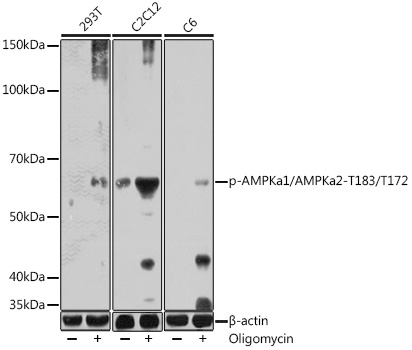
Western blot analysis of various lysates using Phospho-AMPKa1/AMPKa2-T183/T172 Rabbit pAb (AP1171) at 1:1000 dilution. 293T cells were treated with oligomycin (0. 5 uM) at 37°C for 30 minutes. C2C12 cells were treated with oligomycin (0. 5 uM) at 37°C for 30 minutes. C6 cells were treated with oligomycin (0. 5 uM) at 37°C for 30 minutes after serum-starvation overnight. Secondary antibody: HRP-conjugated Goat anti-Rabbit IgG (H+L) (AS014) at 1:10000 dilution. Lysates/proteins: 25µg per lane. Blocking buffer: 3% BSA. Detection: ECL Enhanced Kit (RM00021). Exposure time: 60s. |
Product Guarantee and Expert Support
