

Phospho-PKC alpha-T410+PKC delta-T410 Rabbit mAb, Unconjugated
Catalog Number:
ABB-AP1506
- Images (1)
| Article Name: | Phospho-PKC alpha-T410+PKC delta-T410 Rabbit mAb, Unconjugated |
| Biozol Catalog Number: | ABB-AP1506 |
| Supplier Catalog Number: | AP1506 |
| Alternative Catalog Number: | ABB-AP1506-100UL,ABB-AP1506-20UL,ABB-AP1506-1000UL,ABB-AP1506-500UL |
| Manufacturer: | ABclonal |
| Host: | Rabbit |
| Category: | Antikörper |
| Application: | ELISA, WB |
| Species Reactivity: | Human |
| Immunogen: | Synthetic peptide. This information is considered to be commercially sensitive. |
| Conjugation: | Unconjugated |
| Alternative Names: | AAG6, PKCA, PRKACA, PKCI+/-, PKCalpha, PKC-alpha, Phospho-PKC alpha-T410+PKC delta-T410 |
| Protein kinase C (PKC) is a family of serine- and threonine-specific protein kinases that can be activated by calcium and the second messenger diacylglycerol. PKC family members phosphorylate a wide variety of protein targets and are known to be involved in diverse cellular signaling pathways. PKC family members also serve as major receptors for phorbol esters, a class of tumor promoters. Each member of the PKC family has a specific expression profile and is believed to play a distinct role in cells. The protein encoded by this gene is one of the PKC family members. This kinase has been reported to play roles in many different cellular processes, such as cell adhesion, cell transformation, cell cycle checkpoint, and cell volume control. Knockout studies in mice suggest that this kinase may be a fundamental regulator of cardiac contractility and Ca(2+) handling in myocytes. |
| Application Dilute: | WB,1:1000 - 1:3000|ELISA,Recommended starting concentration is 1 µg/mL. Please optimize the concentration based on your specific assay requirements. |
| Application Notes: | Cross-Reactivity: Human, ResearchArea: Signal Transduction, Protein Phosphorylation, Ser / Thr Kinases, PKC. |
|
|
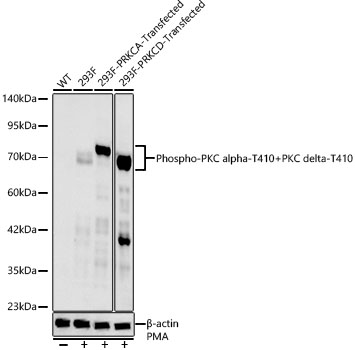
Western blot analysis of lysates from wild type (WT), 293F cells were treated with PMA,293F cells were treated with PMA after transfected with PRKCA and 293F cells were treated with PMA after transfected with PRKCD using Phospho-PKC alpha-T410+PKC delta-T410 Rabbit mAb (AP1506) at 1:2000 dilution. 293F,293F-PRKCA-Transfected and 293F-PRKCD-Transfected cells were treated with PMA (200 nM) at 37°C for 30 minutes. Secondary antibody: HRP-conjugated Goat anti-Rabbit IgG (H+L) (AS014) at 1:10000 dilution. Lysates/proteins: 25µg per lane. Blocking buffer: 3% nonfat dry milk in TBST. Detection: ECL Basic Kit (RM00020). Exposure time: 90s. |
Product Guarantee and Expert Support
