Recombinant Human CX3CL1/Fractalkine Protein
Catalog Number:
ABB-RP01711
Product Overview
Article Name:
Recombinant Human CX3CL1/Fractalkine Protein
Biozol Catalog Number:
ABB-RP01711
Supplier Catalog Number:
RP01711
Alternative Catalog Number:
ABB-RP01711-10UG,ABB-RP01711-50UG,ABB-RP01711-20UG
Manufacturer:
ABclonal
Host:
Yeast
Category:
Proteine/Peptide
Species Reactivity:
Human
Immunogen:
Gln25-Gly100
Alternative Names:
NTN, NTT, CXC3, CXC3C, SCYD1, ABCD-3, C3Xkine, fractalkine, neurotactin
Product Description
Recombinant Human CX3CL1/Fractalkine Protein is produced by Pichia expression system. The target protein is expressed with sequence (Gln25-Gly100) of human CX3CL1/Fractalkine (Accession NP_002987.1) fused with and a 6*His tag at the C-terminus.
Product Properties
Concentration:
< 0.1 EU/µg of the protein by LAL method.
Molecular Weight:
9.47 kDa
Tag:
C-6His
NCBI:
6376
UniProt:
P78423
Source:
Pichia
Purity:
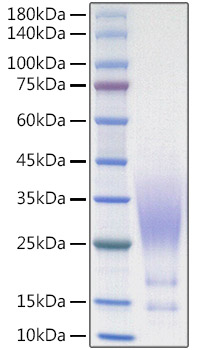
90 % as determined by SDS-PAGE.
Form:
Lyophilized from a 0.22 µm filtered solution of PBS, pH 7.4.
Target:
CX3CL1
Application Notes
Application Dilute:
Lyophilized from a 0.22 µm filtered solution of PBS, pH 7.4.
Application Notes:
ResearchArea: Cytokines & Cytokine receptors. Shipping: Ice Bag
Images
Recombinant Human CX3CL1/Fractalkine Protein was determined by SDS-PAGE under reducing conditions with Coomassie Blue.