Recombinant Rat Oncostatin-M/OSM Protein
Catalog Number:
ABB-RP01844
Product Overview
Article Name:
Recombinant Rat Oncostatin-M/OSM Protein
Biozol Catalog Number:
ABB-RP01844
Supplier Catalog Number:
RP01844
Alternative Catalog Number:
ABB-RP01844-100UG,ABB-RP01844-20UG,ABB-RP01844-50UG,ABB-RP01844-10UG
Manufacturer:
ABclonal
Host:
Human
Category:
Proteine/Peptide
Species Reactivity:
Rat
Immunogen:
Lys26-Arg208
Alternative Names:
Oncostatin-M, OSM
Product Description
Recombinant Rat Oncostatin-M/OSM Protein is produced by HEK293 cells expression system. The target protein is expressed with sequence (Lys26-Arg208) ofRat Oncostatin-M/OSM (Accession NP_001006962.1) fused with a His tag at the C-terminus.
Product Properties
Concentration:
< 0.1 EU/µg of the protein by LAL method.
Molecular Weight:
21.57 kDa
Tag:
C-His
NCBI:
289747
UniProt:
Q65Z15
Source:
HEK293 cells
Purity:
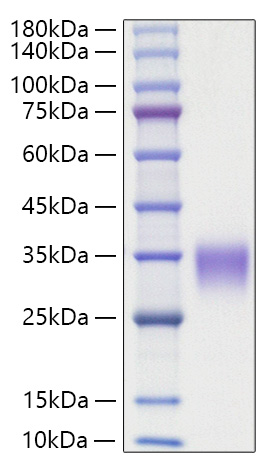
95% as determined by SDS-PAGE.
Form:
Lyophilized from a 0.22 µm filtered solution of PBS, pH 7.4.
Target:
Oncostatin-M/OSM
Application Notes
Application Dilute:
Lyophilized from a 0.22 µm filtered solution of PBS, pH 7.4.
Application Notes:
ResearchArea: Cytokines & Cytokine receptors. Shipping: Ice Bag
Images
Recombinant Rat Oncostatin-M/OSM Protein was determined by SDS-PAGE under reducing conditions with Coomassie Blue.