TLR4, also known as TLR-4, is a member of the Toll-like receptor (TLR) family, which plays a fundamental role in pathogen recognition and activation of innate immunity. TLRs are highly conserved from Drosophila to humans and share structural and functional similarities. They recognize pathogen-associated molecular patterns (PAMPs) that are expressed on infectious agents, and mediate the production of cytokines necessary for the development of effective immunity. TLR4 is most abundantly expressed in placenta, and in myelomonocytic subpopulation of the leukocytes. TLR 4 has also been designated as CD284 (cluster of differentiation 284). It has been implicated in signal transduction events induced by lipopolysaccharide (LPS) found in most gram-negative bacteria. TLR4 Cooperates with LY96 and CD14 to mediate the innate immune response to bacterial lipopolysaccharide (LPS). It acts via MYD88, TIRAP and TRAF6, leading to NF-kappa-B activation, cytokine secretion and the inflammatory response. It is also involved in LPS-independent inflammatory responses triggered by Ni(2+).
Lyophilized from a 0.22 µm filtered solution of 20mM PB, 500mM NaCl, pH 6.0, 10% glycerol.
Target:
TLR4/CD284
Application Dilute:
Lyophilized from a 0.22 µm filtered solution of 20mM PB, 500mM NaCl, pH 6.0, 10% glycerol.
Application Notes:
Cross-Reactivity: Centrifuge the vial before opening. Reconstitute to a concentration of 0.1-0.5 mg/mL in sterile distilled water. Avoid vortex or vigorously pipetting the protein. For long term storage,it is recommended to add a carrier protein or stablizer (e.g. 0.1% BSA,5% HSA,10% FBS or 5% Trehalose),and aliquot the reconstituted protein solution to minimize free-thaw cycles., ResearchArea: Other Recombinant Protein
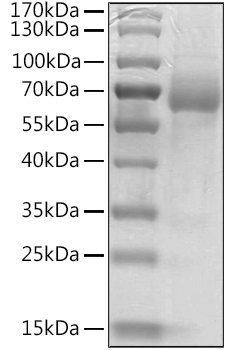
Recombinant Human TLR4/CD284 Protein was determined by SDS-PAGE under reducing conditions with Coomassie Blue.
* VAT and and shipping costs not included. Errors and price changes excepted