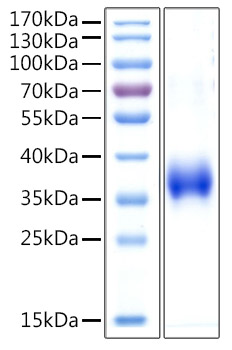
Recombinant Human Cathepsin L Protein

Catalog Number: ABB-RP02825
Article Name: Recombinant Human Cathepsin L Protein
Biozol Catalog Number: ABB-RP02825
Supplier Catalog Number: RP02825
Alternative Catalog Number: ABB-RP02825-50UG
Manufacturer: ABclonal
Host: Human
Category: Proteine/Peptide
Species Reactivity: Human
Immunogen: Thr18-Val333
Alternative Names: Procathepsin L, 3.4.22.15, Cathepsin L1, Major excreted protein, MEP,CTSL
Cathepsin L is a lysosomal cysteine protease that plays a major role in intracellular protein catabolism, and is potent in degrading collagen, laminin, elastin, as well as alpha-1 protease inhibitor and other structural proteins of basement membranes. It is secreted by liver flukes at all stages of their development in the mammalian host, are believed to play important roles in facilitating parasite migration (tissue degradation), feeding and immuno-evasion. Like many proteases, Cathepsin L is synthesized as an inactive preproenzyme, and cleavage of the 96-residue proregion is necessary to generate the fully active 221-residue mature enzyme. Studies have demonstrated that cleavage of the proregion occur autocatalytically under acidic conditions. The enzyme takes part in nutrient acquisition by catabolizing host proteins to absorbable peptides, facilitates the migration of the parasite through the host intestine and liver by cleaving interstitial matrix proteins such as fibronectin, laminin and native collagen and is implicated in the inactivation of host immune defenses by cleaving immunoglobulins. Recently, Cathepsin L has been shown to suppress Th1 immune response in infected laboratory animals making them susceptible to concurrent bacterial infections. Cathepsin L is synthesized in large amounts and secreted by many malignantly transformed cells, and induced by growth factors and tumor promoters. In addition to its role in protein degradation, evidence has accumulated for the participation of Cathepsin L in various physiological and pathological processes, such as tumor invasion and metastasis, bone resorption, spermatogenesis, and arthritis. Accordingly, Cathepsin L may prove useful as a diagnostic or prognostic marker of human tumor malignancy.
Concentration: < 1 EU/µg of the protein by LAL method.
Molecular Weight: 37.3 kDa
Tag: C-His
NCBI: 1514
UniProt: P07711
Source: HEK293 Cells
Purity: 90 % as determined by SDS-PAGE.
Form: Lyophilized from a 0.22 µm filtered solution of 50 mM NaAc, 100 mM NaCl, pH 7.5.
Sequence: TLTFDHSLEAQWTKWKAMHNRLYGMNEEGWRRAVWEKNMKMIELHNQEYREGKHSFTMAMNAFGDMTSEEFRQVMNGFQNRKPRKGKVFQEPLFYEAPRSVDWREKGYVTPVKNQGQCGSCWAFSATGALEGQMFRKTGRLISLSEQNLVDCSGPQGNEGCNGGLMDYAFQYVQDNGGLDSEESYPYEATEESCKYNPKYSVANDTGFVDIPKQEKALMKAVATVGPISVAIDAGHESFLFYKEGIYFEPDCSSE
Target: Cathepsin L
Application Dilute: Lyophilized from a 0.22 µm filtered solution of 50 mM NaAc, 100 mM NaCl, pH 7.5.
Application Notes: Cross-Reactivity: Centrifuge the vial before opening. Reconstitute to a concentration of 0.1-0.5 mg/mL in sterile distilled water. Avoid vortex or vigorously pipetting the protein. For long term storage,it is recommended to add a carrier protein or stablizer (e.g. 0.1% BSA,5% HSA,10% FBS or 5% Trehalose),and aliquot the reconstituted protein solution to minimize free-thaw cycles. ResearchArea: Other Recombinant Protein