Serpins are a group of proteins with similar structures that were first identified as a set of proteins able toinhibit proteases. They are the largest and most diverse family of serine protease inhibitors which are involvedin a number of fundamental biological processes such as blood coagulation, complement activation,fibrinolysis, angiogenesis, inflammation and tumor suppression and are expressed in a cell-specific manner.Serpin E1 is a secreted protein which belongs to the Serpin family. Serpin E1 acts as bait for tissueplasminogen activator, urokinase, and protein C. Its rapid interaction with TPA may function as a major controlpoint in the regulation of fibrinolysis. Defects in SERPINE1 are characterized by abnormal bleeding due toSerpin E1 defect in the plasma. High concentrations of Serpin E1 have been associated with thrombophiliawhich is an autosomal dominant disorder in which affected individuals are prone to develop seriousspontaneous thrombosis.
Lyophilized from a 0.22 µm filtered solution of PBS, pH 7.4.
Application Notes:
Cross-Reactivity: Centrifuge the vial before opening. Reconstitute to a concentration of 0.1-0.5 mg/mL in sterile distilled water. Avoid vortex or vigorously pipetting the protein. For long term storage,it is recommended to add a carrier protein or stablizer (e.g. 0.1% BSA,5% HSA,10% FBS or 5% Trehalose),and aliquot the reconstituted protein solution to minimize free-thaw cycles., ResearchArea: Other Recombinant Protein
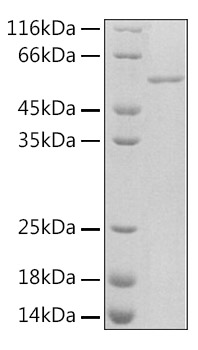
Recombinant Rat Serpin E1/PAI-1 Protein was determined by SDS-PAGE under reducing conditions with Coomassie Blue.
* VAT and and shipping costs not included. Errors and price changes excepted