HSPA1A is a member of the Hsp70 protein family. The 70 kilodalton heat shock proteins (Hsp70s) are a family of ubiquitously expressed heat shock proteins. HSP are abundant and conserved proteins present in all cells. Upon temperature shock or other stress stimuli, HSP is synthesized intracellularly, which may protect cells from protein denaturation or death. Extracellularly, HSP can serve a cytokine function to initiate both innate and adaptive immunity through activation of APC. HSP serves also a chaperone function and facilitates the presentation of antigen peptide to T cells. Molecular chaperones of the Hsp70 family have diverse functions in cells. They assist the folding of newly synthesized and stress-denatured proteins, as well as the import of proteins into organelles, and the dissociation of aggregated proteins. The well-conserved Hsp70 chaperones are ATP dependent: binding and hydrolysis of ATP regulate their interactions with unfolded polypeptide substrates, and ATPase cycling is necessary for their function. All cellular functions of Hsp70 chaperones use the same mechanism of ATP-driven polypeptide binding and release.
Lyophilized from a 0.22 µm filtered solution of PBS, pH 7.4.
Target:
HSP70
Application Dilute:
Lyophilized from a 0.22 µm filtered solution of PBS, pH 7.4.
Application Notes:
Cross-Reactivity: Centrifuge the vial before opening. Reconstitute to a concentration of 0.1-0.5 mg/mL in sterile distilled water. Avoid vortex or vigorously pipetting the protein. For long term storage,it is recommended to add a carrier protein or stablizer (e.g. 0.1% BSA,5% HSA,10% FBS or 5% Trehalose),and aliquot the reconstituted protein solution to minimize free-thaw cycles., ResearchArea: Other Recombinant Protein
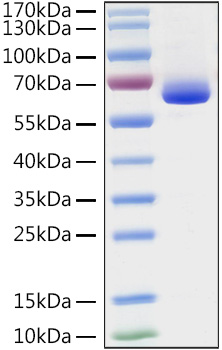
Recombinant Rat HSP70 Protein was determined by SDS-PAGE under reducing conditions with Coomassie Blue.
* VAT and and shipping costs not included. Errors and price changes excepted