Recombinant Mouse Prostaglandin-H2 D-isomerase/PTGDS Protein, Human
Biozol Catalog Number:
ABB-RP02961
Supplier Catalog Number:
RP02961
Alternative Catalog Number:
ABB-RP02961-100UG
Manufacturer:
ABclonal
Host:
Human
Category:
Proteine/Peptide
Species Reactivity:
Mouse
Immunogen:
Met1-Glu189
Alternative Names:
PGD2, PGDS, PGDS2, Ptgs3, L-PGDS
PTGDS, also known as L-PGDS, belongs to the calycin superfamily, lipocalin family. Lipocalins share limited regions of sequence homology and a common tertiary structure architecture. They transport small hydrophobic molecules such as steroids, bilins, retinoids, and lipids. PTGDS is a glutathione-independent prostaglandin D synthase that catalyzes the conversion of PGH2 to PGD2. It is involved in smooth muscle contraction/relaxation and a variety of central nervous system functions. PTGDS may have an anti-apoptotic role in oligodendrocytes. It binds small non-substrate lipophilic molecules, including biliverdin, bilirubin, retinal, retinoic acid and thyroid hormone, and may act as a scavenger for harmful hydrophopic molecules and as a secretory retinoid and thyroid hormone transporter. It is likely to play important roles in both maturation and maintenance of the central nervous system and male reproductive system.
Lyophilized from a 0.22 µm filtered solution of PBS, pH 7.4.
Application Notes:
Cross-Reactivity: Centrifuge the vial before opening. Reconstitute to a concentration of 0.1-0.5 mg/mL in sterile distilled water. Avoid vortex or vigorously pipetting the protein. For long term storage,it is recommended to add a carrier protein or stablizer (e.g. 0.1% BSA,5% HSA,10% FBS or 5% Trehalose),and aliquot the reconstituted protein solution to minimize free-thaw cycles., ResearchArea: Other Recombinant Protein
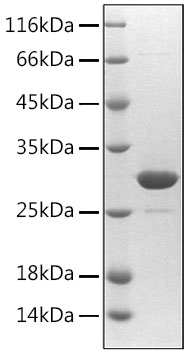
Recombinant Mouse Prostaglandin-H2 D-isomerase/PTGDS Protein was determined by SDS-PAGE under reducing conditions with Coomassie Blue.
* VAT and and shipping costs not included. Errors and price changes excepted