Recombinant Canine CXCL12/SDF-1 Protein, E. coli

Catalog Number: ABB-RP03263
Article Name: Recombinant Canine CXCL12/SDF-1 Protein, E. coli
Biozol Catalog Number: ABB-RP03263
Supplier Catalog Number: RP03263
Alternative Catalog Number: ABB-RP03263-50UG
Manufacturer: ABclonal
Host: E. coli
Category: Proteine/Peptide
Species Reactivity: Canine
Immunogen: Lys22-Met93
Alternative Names: Stromal cell-derived factor 1, SDF-1, C-X-C motif chemokine 12, CXCL12
The human stromal cell-derived factor-1 (SDF1), also known as CXCL12, is a small (8 kDa) cytokine highly conserved chemotactic cytokine belonging to the large family of CXC chemokines. SDF1 is expressed in two isoforms from a single gene that encodes two splice variants, SDF1alpha and SDF1beta, which are identical except for the four residues present in the C-terminus of SDF1beta but absent from SDF1alpha. The chemokine CXCL12 [stromal cell-derived factor-1 (SDF-1)] binds primarily to CXC receptor 4 (CXCR4, CD184). The binding of CXCL12 to CXCR4 induces intracellular signaling through several divergent pathways initiating signals related to chemotaxis, cell survival and/or proliferation, increase in intracellular calcium, and gene transcription. CXCL12 and CXCR4 that have been widely characterized in peripheral tissues and delineate their main functions in the CNS. Extensive evidence supports CXCL12 as a key regulator for early development of the CNS. In the mature CNS, CXCL12 modulates neurotransmission, neurotoxicity and neuroglial interactions. CXCL12 has crucial roles in the formation of multiple organ systems during embryogenesis and in the regulation of bone marrow haematopoiesis and immune function in the postnatal organism. Although considered an important factor in normal bone metabolism, recent studies implicate CXCL12 in the pathogenesis of several diseases involving the skeleton, including rheumatoid arthritis and cancers that metastasize to bone. The CXCL12/CXCR4 axis is involved in tumor progression, angiogenesis, metastasis, and survival. Pathologically enhanced CXCL12 signaling may promote the formation of new vessels through recruiting circulating endothelial progenitor cells or directly enhancing the migration/growth of endothelial cells. Therefore, CXCL12 signaling represents an important mechanism that regulates brain tumor angiogenesis/vasculogenesis and may provide potential targets for anti-angiogenic therapy in malignant gliomas.
Concentration: Please contact us for more information.
Molecular Weight: 8.6 kDa
NCBI: 449622
UniProt: Q3LSL4
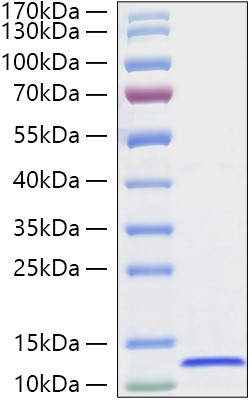
Purity: 95 % as determined by SDS-PAGE.
Form: Lyophilized from a 0.22 µm filtered solution of 50 mM Tris, 500 mM NaCl, pH 8.0. Contact us for customized product form or formulation.
Sequence: KPVSLSYRCPCRFFESHIARANVKHLKILNTPNCALQIVARLKNNSRQVCIDPKLKWIQEYLEKALNKRFKM
Target: CXCL12
Application Dilute: Lyophilized from a 0.22 µm filtered solution of 50 mM Tris, 500 mM NaCl, pH 8.0. Contact us for customized product form or formulation.
Application Notes: Cross-Reactivity: Please contact us for reconstitution instructions. ResearchArea: Cytokines & Cytokine receptors