

Monoclonal Antibody to CD33(Clone: ABM29D3)
Catalog Number:
ABI-10-4064-25
- Images (5)
| Article Name: | Monoclonal Antibody to CD33(Clone: ABM29D3) |
| Biozol Catalog Number: | ABI-10-4064-25 |
| Supplier Catalog Number: | 10-4064-25 |
| Alternative Catalog Number: | ABI-10-4064-25-25UG |
| Manufacturer: | Abeomics |
| Host: | Mouse |
| Category: | Antikörper |
| Application: | FACS, IHC, WB |
| Species Reactivity: | Human |
| Immunogen: | A partial length recombinant CD33 protein (amino acids 28-320) was used as the immunogen for this antibody. |
| Alternative Names: | CD33||SIGLEC3 |
| CD33 is a member of the SIGLEC (Sialic Acid-Binding Ig-Like Lectin) family of receptors, and the gene comprises seven coding exons. Exon 2 encodes the canonical IgV domain, exon 4 encodes the IgC structural domain, and exons 6 and 7 encode cytosolic ITIMs (Immunotyrosine Inhibitory Motifs). CD33 acts as a cell surface antigen which is expressed on normal myeloid cells and CD34+ blasts in AML (Acute Myeloid Leukemia). The antigen serves as a target of GO (Gemtuzumab/Ozogamicin), which exerts anti-leukemic effects in refractory AML. |
| Application Dilute: | Western blot analysis: 2-4 µg/ml, Immunohistochemical analysis: 5 µg/ml FACS: 0.2-0.5 µg/10 6 cells |
|
|
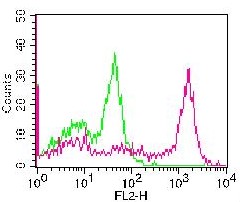
Fig-5: Cell Surface flow analysis of hCD33 in PBMC (Monocytes) using 0.2µg/10 6 cells of CD33 clone ( ABM29D3). Green represents isotype control, red represents anti-hCD33 antibody. Goat anti-mouse PE conjugated secondary antibody (ABEOMICS) was used. |
|
|
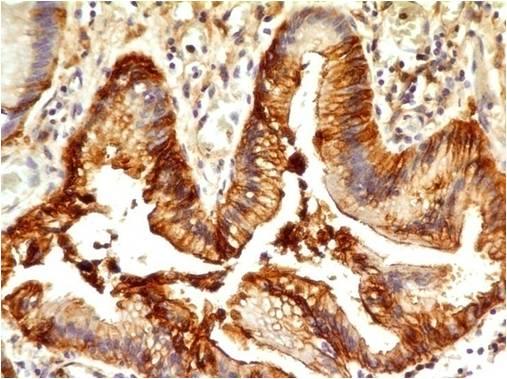
Fig-1: Immunohistochemical analysis of CD33 in adenocarcinoma of rectum using CD33 antibody (Clone: ABM29D3) at 5 µg/ml. |
|
|
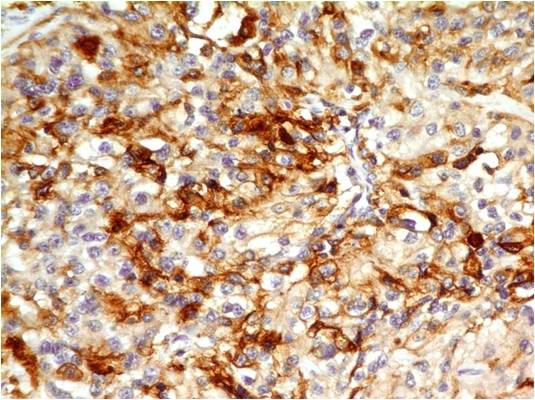
Fig-3: Immunohistochemical analysis of CD33in Renal Cell Carcinoma using CD33 antibody (Clone: ABM29D3) at 5 µg/ml. |
|
|
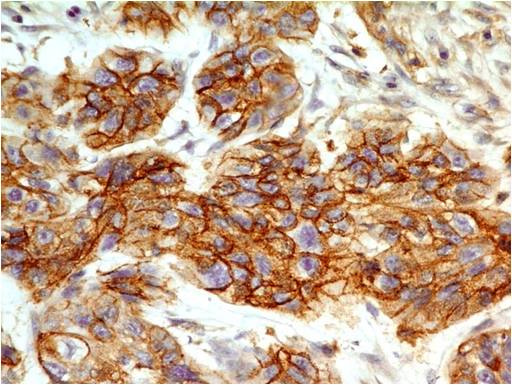
Fig-4: Immunohistochemical analysis of CD33in squamous cell carcinoma of esophagus using CD33 antibody (Clone: ABM29D3) at 5 µg/ml. |
|
|
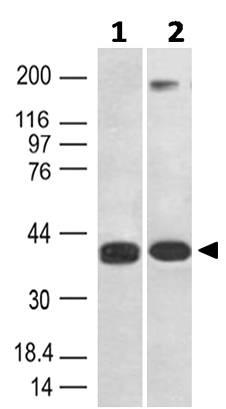
Fig-2: Western blot analysis of CD33. Anti- CD33 antibody (Clone: ABM29D3) was used at 2 µg/ml on Human Spleen and DU145 lysates. |
Product Guarantee and Expert Support
