Coxsackie virus and adenovirus receptor (CXADR) is also known as CAR, is a type I transmembrane glycoprotein for group B coxsackie viruses and subgroup C adenoviruses, and belongs to the CTX family of the Ig superfamily. CAR is strongly expressed in the developing central nervous system. It functions as a homophilic and also as a heterophilic cell adhesion molecule through its interactions with extracellular matrix glycoproteins such as: fibronectin, agrin, laminin1 and tenascinR. Human CXADR protein contains a signal sequence, a extracellular domain (ECD) with a V type (D1) and a C2 type (D2) Iglike domain, a transmembrane segment and a intracellular domain. D1 is thought to be responsible for homodimer formation in trans within tight junctions, and is necessary and sufficient for adenovirus binding. Variants of CXADR are attached to the cell membrane by a GPI anchor. - Proteine/Peptide
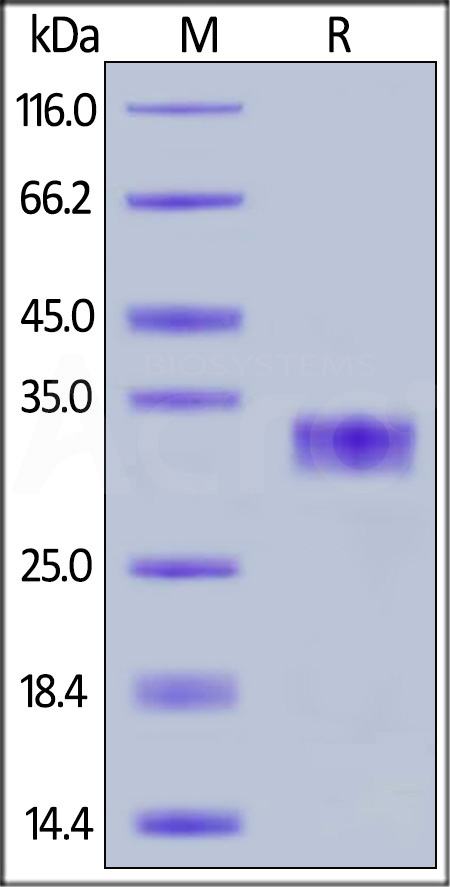
Human CXADR, His Tag on SDS-PAGE under reducing (R) condition. The gel was stained overnight with Coomassie Blue. The purity of the protein is greater than 95%.
* VAT and and shipping costs not included. Errors and price changes excepted