![]()
|
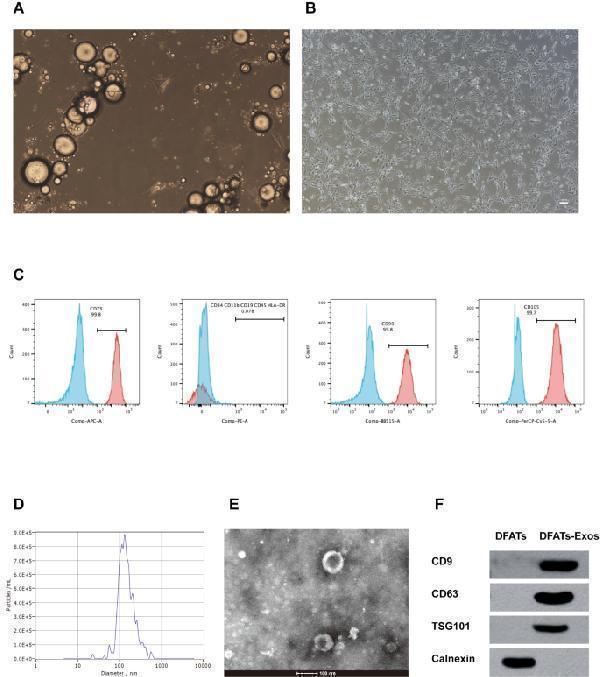
Illustrates the characterization of DFATs and exosomes. DFATs exhibited a spindle-shaped morphology ( A-B ). Flow cytometry analysis showed that DFATs were positive for markers CD90, CD105, and CD73, and negative for CD34, CD11b, CD19, CD45, and HLA-DR ( C ). NTA showed that the average diameter of the exosomes was 136.3 nm ( D ). TEM showed that DFATs-Exos exhibited a typical bilayer membrane structure ( E ). Western blot analysis revealed that DFATs exosomes were enriched in markers such as CD63, CD9, and TSG101, while lacking the marker Calnexin ( F ). Full-length blots are presented in Supplementary Digital Material 1 Index in PubMed under a CC BY license. PMID: 40022232 |
![]()
|
Immunohistochemical analysis of paraffin-embedded Human prostate cancer, using the Antibody at 1:1000 dilution. |
![]()
|
Immunohistochemical analysis of paraffin-embedded Mouse kidney, using the Antibody at 1:1000 dilution. |
![]()
|
Immunohistochemical analysis of paraffin-embedded Rat liver, using the Antibody at 1:500 dilution. |
![]()
|
Immunohistochemical analysis of paraffin-embedded Rat stomach, using the Antibody at 1:500 dilution. |
![]()
|
Immunohistochemical analysis of paraffin-embedded Human tongue cancer, using the Antibody at 1:250 dilution. |
![]()
|
A-C. Prove of urinary extracellular vesicle (uEV) particle existence in the primary analyte samples derived by different uEV isolation methods by ancillary transmission electron microscopy (TEM) (A), fluorescence microscopy (FM) (B) and Western Blotting/Immunoblotting (IB) (C) methods. TEM shows a typical cup-shape EV morphology (EV drying artefact) at 3200ms exposure and either medium 15,000* (bar size = 200nm) or high 43,000* (bar size = 100nm, inlet image) magnification, IB shows known EV protein biomarker expression such as Alix, TSG101, Flotillin-1, CD-9 and PKM1/2 in different subject (S1, S2) uEV samples that are free of Golgi, endoplasmic reticulum or mitochondria organelle contaminants as indicated by the absence of GM130, protein disulfide isomerase (PDI) or pyruvate dehydrogenase (PD) proteins, FM displays green fluorescent signal emitted from SYTO RNASelect-stained internal uEV nucleic acid (RNA) cargo (bar size = 10µm). (D) Linear relationship between raw source sample dose (pre-clarified urine input) and isolated uEV particle concentration (output response) in samples processed by DC (left panel), SiC (middle panel) or PEG (right panel) methods.Index in PubMed under a CC BY license. PMID: 40384173 |
![]()
|
Repeatability of selected urinary extracellular vesicle (uEV) protein content measurements by Multi-Strip Western Blotting (MSWB). (A) The principle of MSWB analysis. Multiple gels were loaded with molecular weight marker (Mr, lanes 1 and 10) and lysates of either individual technical replicate (TR) samples (lanes 3-8) or pooled master TR7 sample in duplicate (lanes 2 and 9) prepared by mixing equal amounts of TR1-TR6 lysates of either uMV or uEXO fractions to resolve proteins by their molecular weight (left panel). After electrophoresis, these gels were cut into strips. Strips that contained the identical antigen of interest, were aligned onto single assembling filter paper, and then transferred onto single nitrocellulose membrane. Following protein transfer, the membrane was blocked and probed with appropriate primary and HRP-conjugated secondary antibodies. For |
![]()
|
Western blot analysis of TSG101 using anti-TSG101 antibody (M01233). Electrophoresis was performed on a 5-20% SDS-PAGE gel at 70V (Stacking gel) / 90V (Resolving gel) for 2-3 hours. The sample well of each lane was loaded with 30 ug of sample under reducing conditions. Lane 1: human Jurkat whole cell lysates,Lane 2: human COLO320 whole cell lysates,Lane 3: human SW620 whole cell lysates,Lane 4: rat brain tissue lysates,Lane 5: rat testis tissue lysates,Lane 6: mouse brain tissue lysates,Lane 7: mouse testis tissue lysates.After electrophoresis, proteins were transferred to a nitrocellulose membrane at 150 mA for 50-90 minutes. Blocked the membrane with 5% non-fat milk/TBS for 1.5 hour at RT. The membrane was incubated with rabbit anti-TSG101 antigen affinity purified monoclonal antibody (Catalog M01233) at 1:500 overnight at 4C, then washed with TBS-0.1%Tween 3 times with 5 minutes each and probed with a goat anti-rabbit IgG-HRP secondary antibody at a dilution of 1:500 for 1.5 hour at RT. The signal is developed using an Enhanced Chemiluminescent detection (ECL) kit (Catalog EK1002) with Tanon 5200 system. A specific band was detected for TSG101 at approximately 44 kDa. The expected band size for TSG101 is at 44 kDa. |