Preservative: 0.01% (w/v) Sodium Azide. Stabilizer: None, Buffer: 0.01 M Sodium Phosphate, 0.15 M Sodium Chloride, pH 7.2
Source:
Sheep
Purity:
This product was prepared from normal serum by a multi-step process which includes delipidation, salt fractionation and ion exchange chromatography followed by papain digestion and extensive dialysis against the buffer stated above. Assay by immunoelectrophoresis resulted in a single precipitin arc against anti-Sheep Serum, anti-Sheep IgG and anti-Sheep IgG F(ab)2. No reaction was observed against anti-Sheep IgG F(c) or anti- Papain.
Form:
Liquid (sterile filtered)
Application Notes:
Biological Origin: Sheep. Application Notes: Sheep IgG Fab fragment reagents are ideal for ELISA, western blotting, lateral flow, Immunohistochemistry, as well as other antibody detection methods
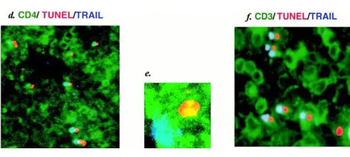
Immunofluorescent analysis for death-inducing ligands and their receptors in spleens from HIV-1-infected hu-PBL-NOD-SCID mice. (d) Triple staining for human CD4 (FITC, green), TUNEL (TRITC, red), and TRAIL (Cy5, blue) (magnification *100). Merging of green and blue is shown as light blue. Merging of green and red is shown as orange. (e) High magnification (*500) of d showing a TUNEL + CD4+ T cell conjugated with a TRAIL + CD4+ T cell (blue). Light blue indicates merging of green and blue. (f) Triple immunostaining for human CD3 (FITC, green), TUNEL (TRITC, red), and TRAIL (Cy5, blue) (magnification *200). Merging of green and blue is shown as light blue. Merging of green and red is shown as orange. Sheep IgG Fab fragment (p/n orb346370).
Removal of EOLC causes nociception.(A) Rats were treated with i.p. DigiFab or Fab and their mechanical aversive threshold determined using the von-Frey method hourly over 4 hours. Means (SEM) displayed, n = 8-12 rats per group. (B-F): Rats were treated with i.c.v. DigiFab or Fab control. (B) The aversive threshold response to von Frey hairs is displayed as an average of both hindpaws before and for 4 hours after i.c.v. pre-treatment with Fab control or DigiFab. Means (SEM) displayed, n = 4 rats per group. (C) The eyelid closure response was measured before and hourly for 4 hours after pre-treatment with DigiFab or Fab control.
* VAT and and shipping costs not included. Errors and price changes excepted