Protein A has a high affinity for the Fc regions of IgG molecules from a variety of species, including human, mouse, rat IgG2c, cow IgG2c, goat IgG2, sheep IgG2, and rabbit. Immobilization of protein A creates an affinity resin that can be used to isolate IgG fractions from crude serum, ascites fluid or hybridoma supernatants/dilute cell cultures. High capacity and high flow rate fractionation is applicable to both laboratory and scale-up processes. Sepharose Protein A can be used for immunoprecipitation and purification of monoclonal antibodies.
Form:
Suspension of agarose beads
Application Dilute:
IP: User Optimized
Application Notes:
Application Notes: Protein A resin may also be used to pull down antibody:antigen complexes in immunoprecipitation experiments. This product is suitable for use at 20 µL per immunoprecipitation reaction
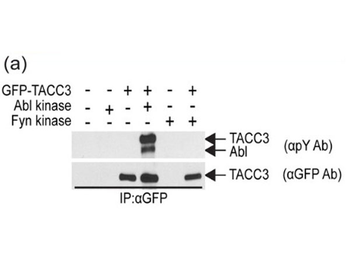
Abelson kinase induces phosphorylation of TACC3 Abelson kinase induces phosphorylation of TACC3. (a) Western blot performed with phospho-tyrosine specific antibody showing Abelson-induced tyrosine phosphorylation of full-length TACC3 (lane 4). Phosphorylation signal is not present when TACC3 is expressed alone (lane 2) or with another tyrosine kinase Fyn (lane 6). Total protein was incubated with alpha-GFP and 20 µl of a 50% slurry of sepharose Protein A (p/n orb348753) and Protein G resin prewashed with lysis buffer.
Antibody-binding protein specificity for Protein A, Protein G, and Protein A/G which demonstrate binding specificity to IgG immunoglobulin through an interaction in the Fc region of the heavy chain domain. Protein A and G each show some preferences to certain types of antibody subclasses, and proper reagent selection may be required, Protein A/G offers the widest range of antibody subclass binding. Another immunoglobulin binding protein is Protein L which binds to the kappa light chain of the F(ab)2 region.
BRD4 directly interacts with eRNAs through its tandem bromodomains. d, f, In vitro pull-down of MMP9 and CCL2 eRNAs with the indicated FLAG-tagged BRD4 proteins and g, the His-tagged tandem BDs of BRD2, BRD3, BRD4, and BRDT and the single BDs of BRG1 and BRD7 as revealed by SYBR Gold staining and SDS-PAGE/Coomassie staining analyses of the purified proteins. Cleared lysates were incubated with indicated antibodies followed by an additional incubation with Protein A Sepharose (p/n orb348753).
Mutp53 and NFkappaB interact and impact each others binding at enhancers. a Purified wild-type and mutp53 proteins bind directly to purified NFkappaB/p65 as revealed by immunoblot analysis with an antibody that recognizes p65. Input samples for the p53 proteins were also analyzed by immunoblot analysis with an antibody that recognizes both wild-type and mutp53. Three independent interaction assays were performed.
* VAT and and shipping costs not included. Errors and price changes excepted