The antiserum was produced against synthesized peptide derived from human Cyclin E1 around the phosphorylation site of Thr395. AA range:361-410
Alternative Names:
CCNE1, CCNE, G1/S-specific cyclin-E1
The protein encoded by this gene belongs to the highly conserved cyclin family, whose members are characterized by a dramatic periodicity in protein abundance through the cell cycle. Cyclins function as regulators of CDK kinases. Different cyclins exhibit distinct expression and degradation patterns which contribute to the temporal coordination of each mitotic event. This cyclin forms a complex with and functions as a regulatory subunit of CDK2, whose activity is required for cell cycle G1/S transition. This protein accumulates at the G1-S phase boundary and is degraded as cells progress through S phase. Overexpression of this gene has been observed in many tumors, which results in chromosome instability, and thus may contribute to tumorigenesis. This protein was found to associate with, and be involved in, the phosphorylation of NPAT protein (nuclear protein mapped to the ATM locus), which participates in
Western Blot: 1/500 - 1/2000. Immunohistochemistry: 1/100 - 1/300. ELISA: 1/10000. Not yet tested in other applications.
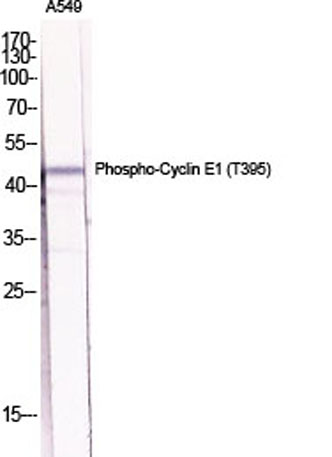
Western Blot analysis of various cells using Phospho-Cyclin E1 (T395) Polyclonal Antibody diluted at 1:2000
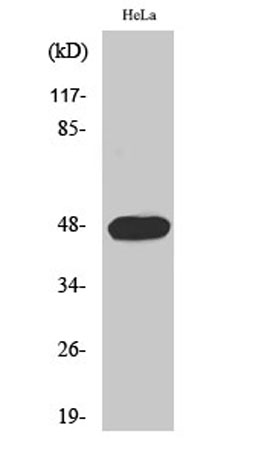
Western Blot analysis of HeLa cells using Phospho-Cyclin E1 (T395) Polyclonal Antibody diluted at 1:2000
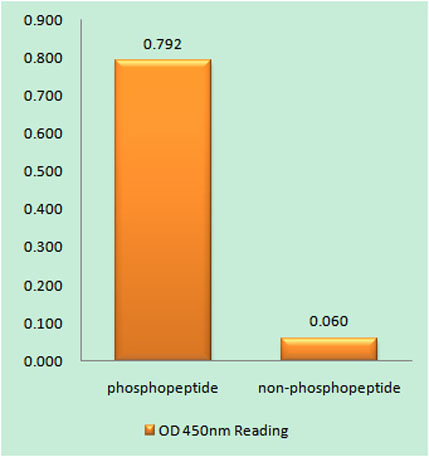
Enzyme-Linked Immunosorbent Assay (Phospho-ELISA) for Immunogen Phosphopeptide (Phospho-left) and Non-Phosphopeptide (Phospho-right), using Cyclin E1 (Phospho-Thr395) Antibody
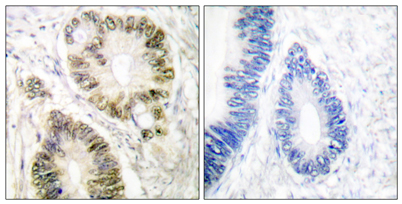
Immunohistochemistry analysis of paraffin-embedded human colon carcinoma, using Cyclin E1 (Phospho-Thr395) Antibody. The picture on the right is blocked with the phospho peptide.
* VAT and and shipping costs not included. Errors and price changes excepted