The protein encoded by this gene belongs to the highly conserved cyclin family, whose members are characterized by a dramatic periodicity in protein abundance throughout the cell cycle. Cyclins function as regulators of CDK kinases. Different cyclins exhibit distinct expression and degradation patterns which contribute to the temporal coordination of each mitotic event. This cyclin forms a complex with and functions as a regulatory subunit of CDK4 or CDK6, whose activity is required for cell cycle G1/S transition. This protein has been shown to interact with tumor suppressor protein Rb and the expression of this gene is regulated positively by Rb. Mutations, amplification and overexpression of this gene, which alters cell cycle progression, are observed frequently in a variety of tumors and may contribute to tumorigenesis. [provided by RefSeq, Jul 2008],
Western Blot: 1/500 - 1/2000. Immunohistochemistry: 1/100 - 1/300. ELISA: 1/10000. Not yet tested in other applications.
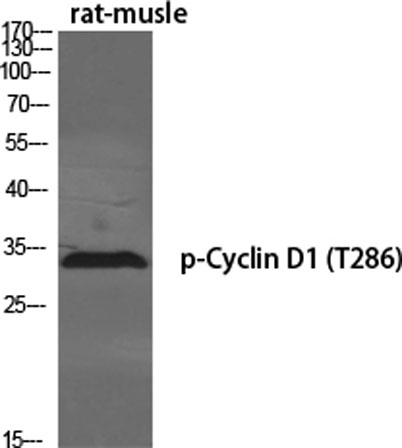
Western Blot analysis of various cells using Phospho-Cyclin D1 (T286) Polyclonal Antibody diluted at 1:500
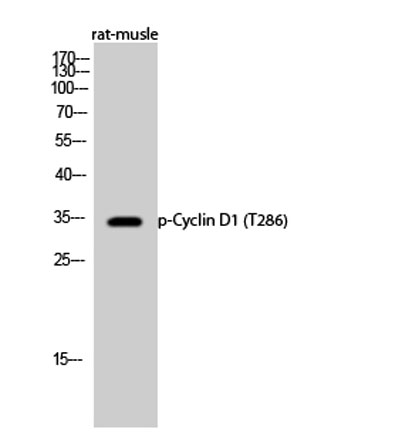
Western Blot analysis of rat-musle cells using Phospho-Cyclin D1 (T286) Polyclonal Antibody diluted at 1:500
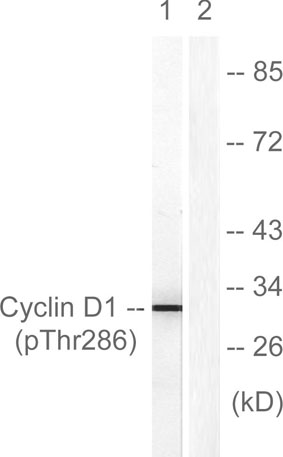
Western blot analysis of lysates from Jurkat cells treated with EGF 200ng/ml 30, using Cyclin D1 (Phospho-Thr286) Antibody. The lane on the right is blocked with the phospho peptide.
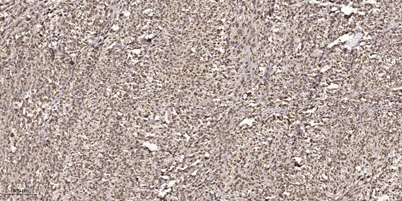
Immunohistochemical analysis of paraffin-embedded human small intestinal carcinoma tissue. 1,primary Antibody was diluted at 1:200(4 overnight). 2, Sodium citrate pH 6.0 was used for antigen retrieval(>98C,20min). 3,Secondary antibody was diluted at 1:200
* VAT and and shipping costs not included. Errors and price changes excepted