CASP9 encodes a member of the cysteine-aspartic acid protease (caspase) family. Sequential activation of caspases plays a central role in the execution-phase of cell apoptosis. Caspases exist as inactive proenzymes which undergo proteolytic processing at conserved aspartic residues to produce two subunits, large and small, that dimerize to form the active enzyme. Caspase 9 can undergo autoproteolytic processing and activation by the apoptosome, a protein complex of cytochrome c and the apoptotic peptidase activating factor 1, this step is thought to be one of the earliest in the caspase activation cascade. Caspase 9 is thought to play a central role in apoptosis and to be a tumor suppressor. Alternative splicing results in multiple transcript variants.
Western Blot: 1/500 - 1/2000. Immunohistochemistry: 1/100 - 1/300. ELISA: 1/5000. Not yet tested in other applications.
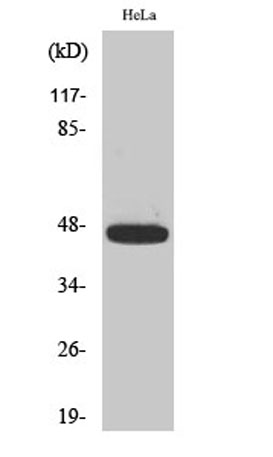
Western Blot analysis of various cells using Phospho-Caspase-9 (T125) Polyclonal Antibody diluted at 1:500
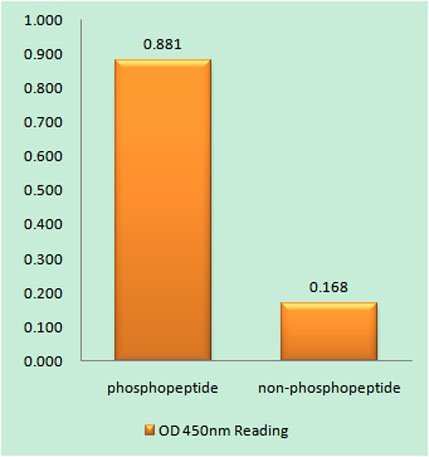
Enzyme-Linked Immunosorbent Assay (Phospho-ELISA) for Immunogen Phosphopeptide (Phospho-left) and Non-Phosphopeptide (Phospho-right), using Caspase 9 (Phospho-Thr125) Antibody
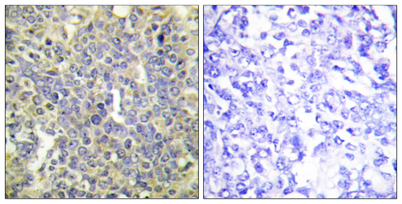
Immunohistochemistry analysis of paraffin-embedded human lung carcinoma, using Caspase 9 (Phospho-Thr125) Antibody. The picture on the right is blocked with the phospho peptide.
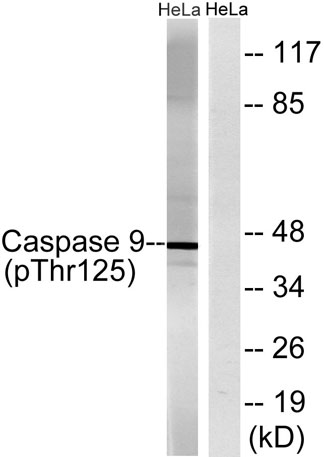
Western blot analysis of lysates from HeLa cells treated with TNF 20ng/ml 5+calyculinA 50ng/ml 5, using Caspase 9 (Phospho-Thr125) Antibody. The lane on the right is blocked with the phospho peptide.
* VAT and and shipping costs not included. Errors and price changes excepted