This gene encodes a member of the epidermal growth factor (EGF) receptor family of receptor tyrosine kinases. This protein has no ligand binding domain of its own and therefore cannot bind growth factors. However, it does bind tightly to other ligand-bound EGF receptor family members to form a heterodimer, stabilizing ligand binding and enhancing kinase-mediated activation of downstream signalling pathways, such as those involving mitogen-activated protein kinase and phosphatidylinositol-3 kinase. Allelic variations at amino acid positions 654 and 655 of isoform a (positions 624 and 625 of isoform b) have been reported, with the most common allele, Ile654/Ile655, shown here. Amplification and/or overexpression of this gene has been reported in numerous cancers, including breast and ovarian tumors. Alternative splicing results in several additional transcript variants, some encoding d
Western Blot: 1/500 - 1/2000. Immunohistochemistry: 1/100 - 1/300. Immunofluorescence: 1/200 - 1/1000. ELISA: 1/40000. Not yet tested in other applications.
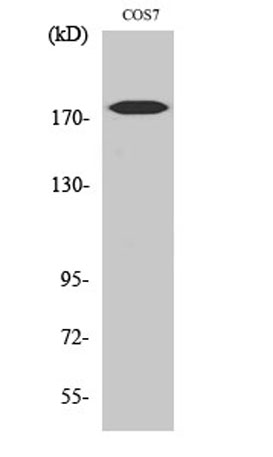
Western Blot analysis of various cells using Phospho-Neu (Y1221/Y1222) Polyclonal Antibody
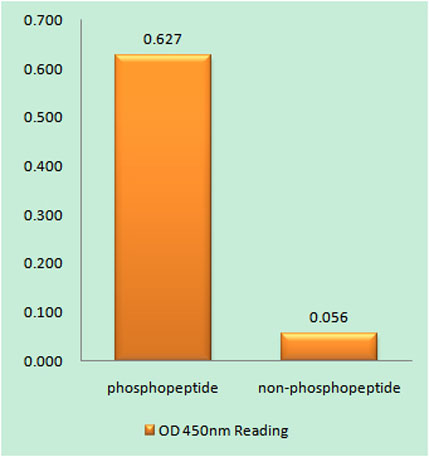
Enzyme-Linked Immunosorbent Assay (Phospho-ELISA) for Immunogen Phosphopeptide (Phospho-left) and Non-Phosphopeptide (Phospho-right), using HER2 (Phospho-Tyr1221+Tyr1222) Antibody
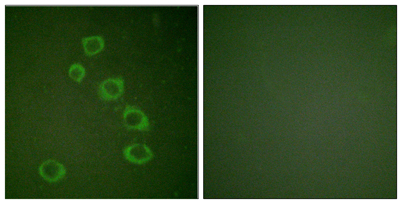
Immunofluorescence analysis of HuvEc cell, using HER2 (Phospho-Tyr1221+Tyr1222) Antibody. The lane on the right is blocked with the HER2 (Phospho-Tyr1221+Tyr1222) peptide.
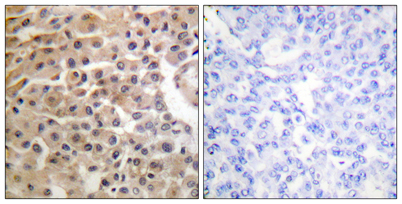
Immunohistochemistry analysis of paraffin-embedded human breast cancer, using HER2 (Phospho-Tyr1221+Tyr1222) Antibody. The picture on the right is blocked with the HER2 (Phospho-Tyr1221+Tyr1222) peptide.
* VAT and and shipping costs not included. Errors and price changes excepted