The antiserum was produced against synthesized peptide derived from human SEPARASE around the phosphorylation site of Ser801. AA range:767-816
Alternative Names:
ESPL1, ESP1, KIAA0165, Separin, Caspase-like protein ESPL1, Extra spindle poles-like 1 protein, Separase
Stable cohesion between sister chromatids before anaphase and their timely separation during anaphase are critical for chromosome inheritance. In vertebrates, sister chromatid cohesion is released in 2 steps via distinct mechanisms. The first step involves phosphorylation of STAG1 (MIM 604358) or STAG2 (MIM 300826) in the cohesin complex. The second step involves cleavage of the cohesin subunit SCC1 (RAD21, MIM 606462) by ESPL1, or separase, which initiates the final separation of sister chromatids (Sun et al., 2009 [PubMed 19345191]).[supplied by OMIM, Nov 2010],
Western Blot: 1/500 - 1/2000. Immunohistochemistry: 1/100 - 1/300. Immunofluorescence: 1/200 - 1/1000. ELISA: 1/40000. Not yet tested in other applications.
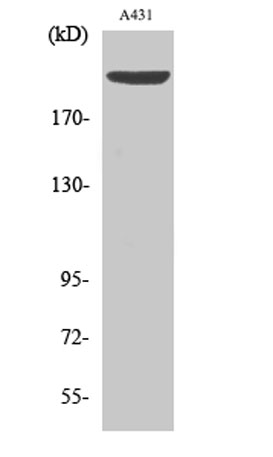
Western Blot analysis of various cells using Phospho-Separase (S801) Polyclonal Antibody diluted at 1:1000
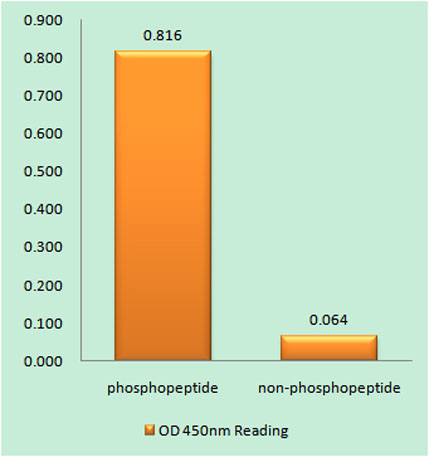
Enzyme-Linked Immunosorbent Assay (Phospho-ELISA) for Immunogen Phosphopeptide (Phospho-left) and Non-Phosphopeptide (Phospho-right), using SEPARASE (Phospho-Ser801) Antibody
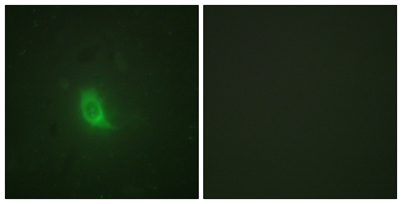
Immunofluorescence analysis of HUVEC cells, using SEPARASE (Phospho-Ser801) Antibody. The picture on the right is blocked with the phospho peptide.
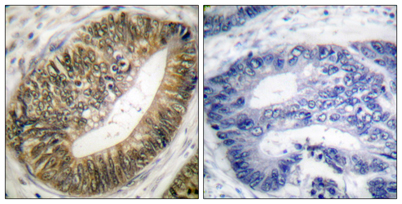
Immunohistochemistry analysis of paraffin-embedded human colon carcinoma, using SEPARASE (Phospho-Ser801) Antibody. The picture on the right is blocked with the phospho peptide.
* VAT and and shipping costs not included. Errors and price changes excepted