The antiserum was produced against synthesized peptide derived from human BCLW. AA range:131-180
Alternative Names:
BCL2L2, BCLW, KIAA0271, Bcl-2-like protein 2, Bcl2-L-2, Apoptosis regulator Bcl-W
This gene encodes a member of the BCL-2 protein family. The proteins of this family form hetero- or homodimers and act as anti- and pro-apoptotic regulators. Expression of this gene in cells has been shown to contribute to reduced cell apoptosis under cytotoxic conditions. Studies of the related gene in mice indicated a role in the survival of NGF- and BDNF-dependent neurons. Mutation and knockout studies of the mouse gene demonstrated an essential role in adult spermatogenesis. Alternative splicing results in multiple transcript variants. Read-through transcription also exists between this gene and the neighboring downstream PABPN1 (poly(A) binding protein, nuclear 1) gene. [provided by RefSeq, Dec 2010],
Western Blot: 1/500 - 1/2000. Immunohistochemistry: 1/100 - 1/300. Immunofluorescence: 1/200 - 1/1000. ELISA: 1/10000. Not yet tested in other applications.
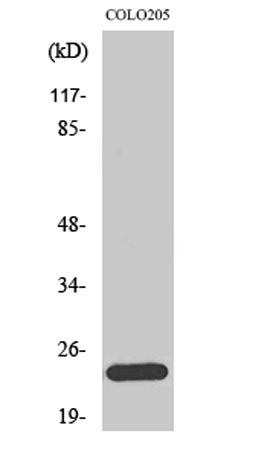
Western Blot analysis of various cells using Bcl-w Polyclonal Antibody diluted at 1:2000
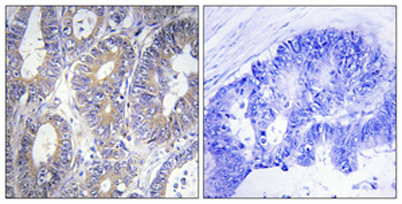
Immunohistochemical analysis of paraffin-embedded Human colon cancer. Antibody was diluted at 1:100(4 overnight). High-pressure and temperature Tris-EDTA,pH8.0 was used for antigen retrieval. Negetive contrl (right) obtaned from antibody was pre-absorbed by immunogen peptide.
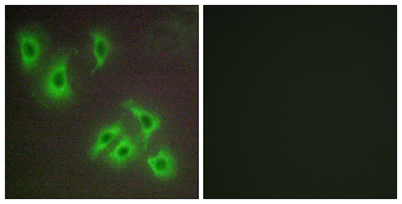
Immunofluorescence analysis of HepG2 cells, using BCLW Antibody. The picture on the right is blocked with the synthesized peptide.
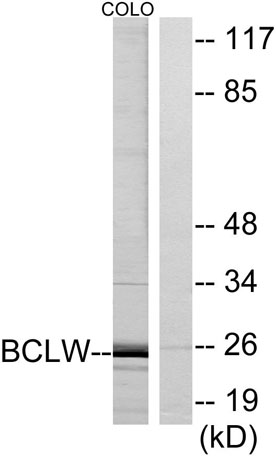
Western blot analysis of lysates from COLO cells, using BCLW Antibody. The lane on the right is blocked with the synthesized peptide.
* VAT and and shipping costs not included. Errors and price changes excepted