Synthesized peptide derived from human ATPK AA range: 38-88
Mitochondrial ATP synthase catalyzes ATP synthesis, utilizing an electrochemical gradient of protons across the inner membrane during oxidative phosphorylation. It is composed of two linked multi-subunit complexes: the soluble catalytic core, F1, and the membrane-spanning component, Fo, which comprises the proton channel. The catalytic portion of mitochondrial ATP synthase consists of five different subunits (alpha, beta, gamma, delta, and epsilon) assembled with a stoichiometry of 3 alpha, 3 beta, and single representatives of the gamma, delta, and epsilon subunits. The proton channel likely has nine subunits (a, b, c, d, e, f, g, F6 and 8). This gene encodes the f subunit of the Fo complex. Alternatively spliced transcript variants encoding different isoforms have been identified for this gene. This gene has multiple pseudogenes. Naturally occurring read-through transcription also exists between this gene and the downstream pentatricopeptide repeat domain 1 (PTCD1) gene. [provided by RefSeq, Nov 2010],
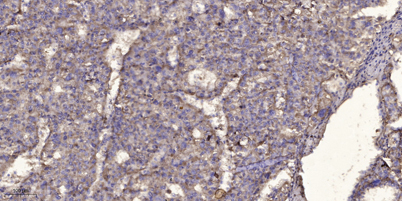
Immunohistochemical analysis of paraffin-embedded human liver cancer. 1, Antibody was diluted at 1:200(4 overnight). 2, Tris-EDTA,pH9.0 was used for antigen retrieval. 3,Secondary antibody was diluted at 1:200(room temperature, 45min).
* VAT and and shipping costs not included. Errors and price changes excepted