Basic helix loop helix transcription factor scleraxis, bHLHa41, bHLHa48, Class A basic helix-loop-helix protein 41, Class A basic helix-loop-helix protein 48, scleraxis homolog A, SCX, SCXB
Transcription factors are proteins that bind DNA adjacent to genes and control the production of mRNA transcripts. Scleraxis (basic helix-loop-helix transcription factor scleraxis) is a 201 amino acid protein that dimerizes with another bHLH protein to initiate transcription. Scleraxis is known to play a role in formation of mesoderm and somite-derived chondrogenic lineages. Scleraxis localizes to the nucleus and contains one bHLH domain. bHLH transcription factors, in general, function in cellular differentiation, proliferation, and oncogene regulation. The gene encoding Scleraxis maps to human chromosome 8, which consists of nearly 146 million base pairs, houses more than 800 genes and is associated with a variety of diseases and malignancies. Schizophrenia, bipolar disorder, Trisomy 8, Pfeiffer syndrome, congenital hypothyroidism, Waardenburg syndrome and some leukemias and lymphomas are thought to occur as a result of defects in specific genes that map to chromosome 8.
200ug/ml of Ab purified from Bioreactor Concentrate by Protein A/G. Prepared in 10mM PBS with 0.05% BSA & 0.05% azide. Also available WITHOUT BSA & azide at 1.0mg/ml.
Antibody Type:
Monoclonal Antibody
Application Notes:
Flow Cytometry (1-2ug/million cells), Immunofluorescence (1-2ug/ml), ,Optimal dilution for a specific application should be determined.
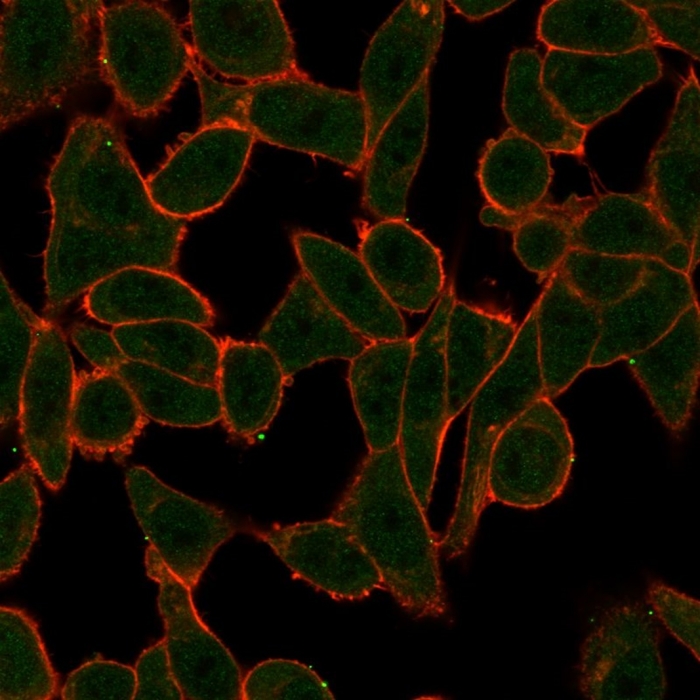
Immunofluorescence Analysis of HeLa cells using SCXA Mouse Monoclonal Antibody (PCRP-SC
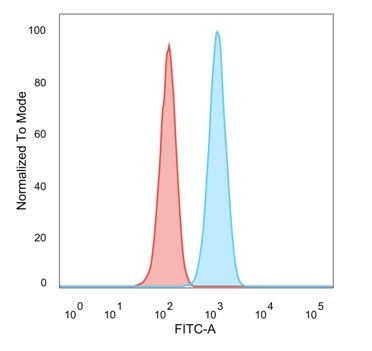
Flow Cytometric Analysis of PFA-fixed HeLa cells. SCXA Mouse Monoclonal Antibody (PCRP-SCXA-2D11) followed by goat anti-mouse IgG-CF488 (blue), unstained cells (red).
Immunofluorescence Analysis of HeLa cells using SCXA Mouse Monoclonal Antibody (PCRP-SCXA-2D11) followed by goat anti-mouse IgG-CF488 (green). CF640A phalloidin (red).
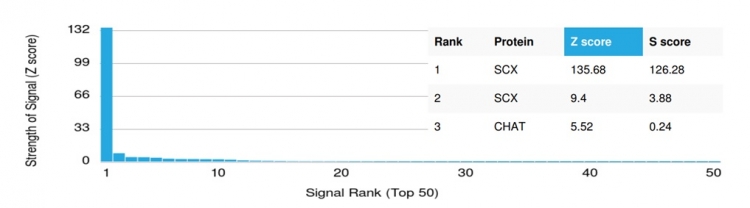
Analysis of Protein Array containing more than 19,000 full-length human proteins using SCXA Mouse Monoclonal Antibody (PCRP-SCXA-2D11). Z- and S- Score: The Z-score represents the strength of a signal that a monoclonal antibody (MAb) (in combination with a fluorescently-tagged anti-IgG secondary antibody) produces when binding to a particular protein on the HuProtTM array. Z-scores are described in units of standard deviations (SDs) above the mean value of all signals generated on that array. If targets on HuProtTM are arranged in descending order of the Z-score, the S-score is the difference (also in units of SDs) between the Z-score. S-score therefore represents the relative target specificity of a MAb to its intended target. A MAb is considered to specific to its intended target, if the MAb has an S-score of at least 2.5. For example, if a MAb binds to protein X with a Z-score of 43 and to protein Y with a Z-score of 14, then the S-score for the binding of that MAb to protein X is equal to 29.
* VAT and and shipping costs not included. Errors and price changes excepted