This antibody was prepared from whole rabbit serum produced by repeated immunizations with a synthetic peptide corresponding to amino acids 419-427 of Human DDB2 (C-terminal) coupled to KLH.
Conjugation:
Unconjugated
Alternative Names:
rabbit anti-p48-DDB2 Antibody, damage-specific DNA binding protein 2 antibody, UV-DDB 2 antibody
ELISA: 1:2,000 - 1:10,000, IHC: User Optimized, IP: User Optimized, WB: 1:500 - 1:1,000
Application Notes:
This antibody reacts with human DDB2 tested by western blot and immunoprecipitation. The antibody immunoprecipitates in vitro translated protein and protein from cell lysates (using 293T, and others). Coimmunoprecipitation of related proteins has not bee
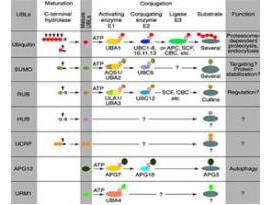
Most modifiers mature by proteolytic processing from inactive precursors (a, amino acid). Arrowheads point to the cleavage sites. Ubiquitin is expressed either as polyubiquitin or as a fusion with ribosomal proteins. Conjugation requires activating (E1) and conjugating (E2) enzymes that form thiolesters (S) with the modifiers. Modification of cullins by RUB involves SCF(SKP1/cullin-1/F-box protein) /CBC(cullin-2/elongin B/elonginC) -like E3 enzymes that are also involved in ubiquitination. In contrast to ubiquitin, the UBLs do not seem to form multi-UBL chains. UCRP(ISG15) resembles two ubiquitin moieties linked head-to-tail. Whether HUB1 functions as a modifier is currently unclear. APG12 and URM1 are distinct from the other modifiers because they are unrelated in sequence to ubiquitin. Data contributed by S.Jentsch.
* VAT and and shipping costs not included. Errors and price changes excepted