Anti-ETO Antibody was produced in rabbits by repeated immunizations with human ETO using two synthetic peptides containing sequences from the N-terminal and internal region of the protein respectively.
Conjugation:
Unconjugated
Alternative Names:
Protein CBFA2T1, Cyclin-D-related protein, Eight twenty one protein, Protein ETO, Protein MTG8, Zinc finger MYND domain-containing protein 2, AML1T1, CBFA2T1, CDR, ETO, MTG8, ZMTND2
Anti-ETO Antibody has been tested in ChIP and ELISA. Specific conditions for reactivity should be optimized by the end user.
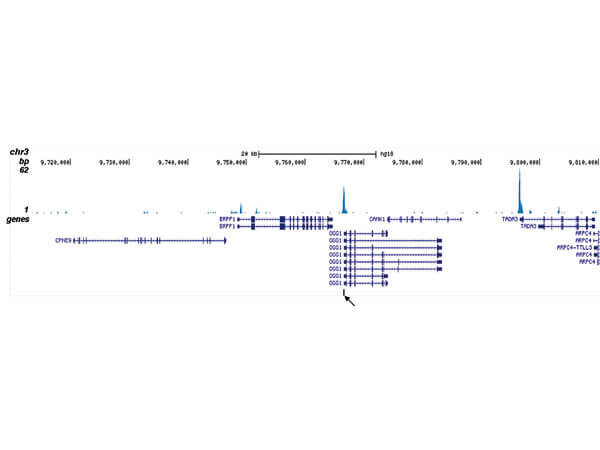
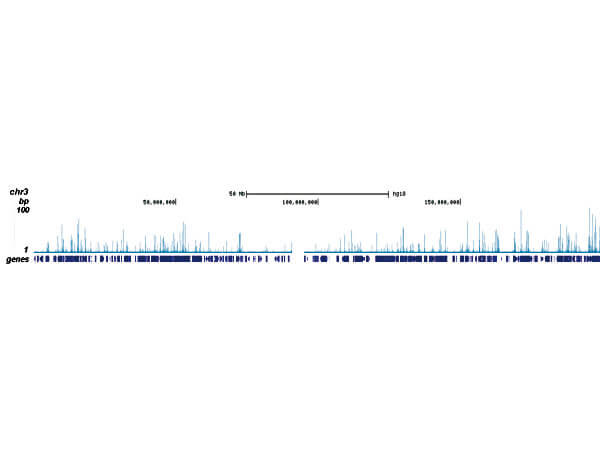
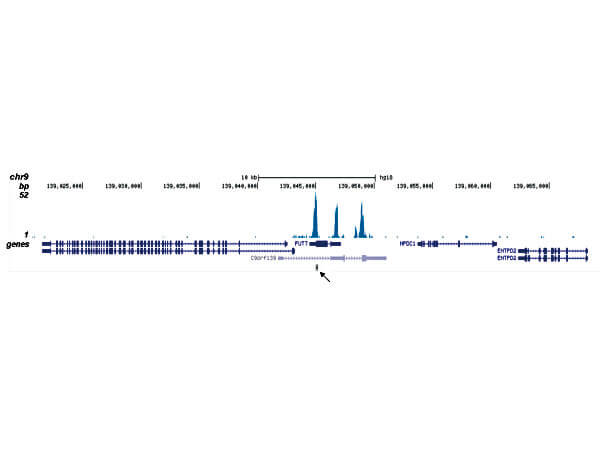
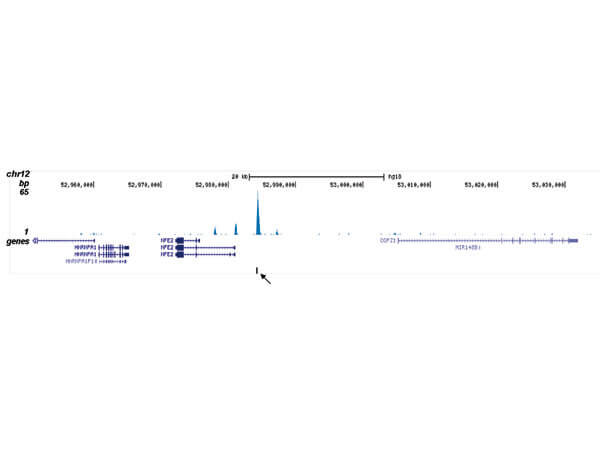
ChIP-seq results of anti-ETO antibody. ChIP was performed as described in figure 1. The IPd DNA of 6 ChIPs were pooled and analysed with an Illumina Genome Analyzer. Library preparation, cluster generation, and sequencing were performed according to the manufacturers instructions. The 32 bp tags were aligned to the human reference genome (hg18) using the ELAND algorithm. Figure 2 shows the results of the complete chromosome 3. Figures 3-5 shows three genomic regions surrounding the OGG1, FUT7 and NFE2 genes, respectively. The position of the PCR amplicon is indicated with an arrow.
ChIP-seq results of anti-ETO antibody. ChIP was performed as described in figure 1. The IPd DNA of 6 ChIPs were pooled and analyzed with an Illumina Genome Analyzer. Library preparation, cluster generation, and sequencing were performed according to the manufacturers instructions. The 32 bp tags were aligned to the human reference genome (hg18) using the ELAND algorithm. Figure 2 shows the results of the complete chromosome 3. Figures 3-5 shows three genomic regions surrounding the OGG1, FUT7 and NFE2 genes, respectively. The position of the PCR amplicon is indicated with an arrow.
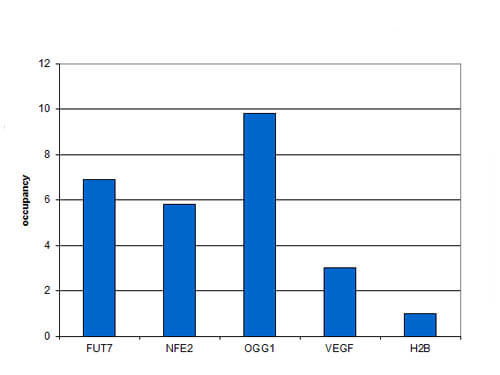
Chromatin Immunoprecipitation results of Rabbit Anti-human ETO Antibody. Chromatin from 1.25 million formaldehyde cross-linked SKNO-1 cells was used with 4ul of Anti-human ETO Antibody and 20ul of magnetic IgG beads per immunoprecipitation. QPCR was performed using primers specific for the FUT7, NFE2, OGG1 and VEGF genes. ChIP results shows the occupancy, calculated as the ratio + control/background for which the H2B gene was used.
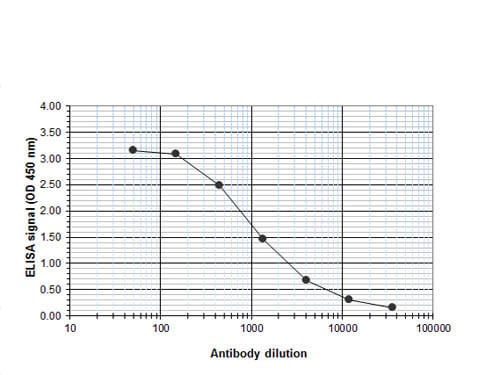
ELISA results of Rabbit anti-human ETO antibody. Antigen: BSA conjugated ETO. Coating amount: 0.1 µg per well. Dilution series: serial dilution. Estimated Antibody Titer to be 1:1,300. Substrate: TMB (p/n TMBE-1000).
ChIP-seq results of anti-ETO antibody. ChIP was performed as described in figure 1. The IPd DNA of 6 ChIPs were pooled and analysed with an Illumina Genome Analyzer. Library preparation, cluster generation, and sequencing were performed according to the manufacturers instructions. The 32 bp tags were aligned to the human reference genome (hg18) using the ELAND algorithm. Figure 2 shows the results of the complete chromosome 3. Figures 3-5 shows three genomic regions surrounding the OGG1, FUT7 and NFE2 genes, respectively. The position of the PCR amplicon is indicated with an arrow.
ChIP-seq results of anti-ETO antibody. ChIP was performed as described in figure 1. The IPd DNA of 6 ChIPs were pooled and analysed with an Illumina Genome Analyzer. Library preparation, cluster generation, and sequencing were performed according to the manufacturers instructions. The 32 bp tags were aligned to the human reference genome (hg18) using the ELAND algorithm. Figure 2 shows the results of the complete chromosome 3. Figures 3-5 shows three genomic regions surrounding the OGG1, FUT7 and NFE2 genes, respectively. The position of the PCR amplicon is indicated with an arrow.
* VAT and and shipping costs not included. Errors and price changes excepted