This affinity purified antibody was prepared from whole goat serum produced by repeated immunizations with a synthetic peptide corresponding to an internal region near aa 625-675 of Human AP1G1.
Conjugation:
Unconjugated
Alternative Names:
goat anti-AP1G1 Antibody, AP-1 complex subunit gamma-1, Adapter-related protein complex 1 subunit gamma-1, Adaptor protein complex AP-1 subunit gamma-1, Golgi adaptor HA1/AP1 adaptin subunit gamma-1, Gamma1-adaptin, Clathrin assembly protein complex 1 gamma-1 large chain, ADTG, CLAPG1, AP1G
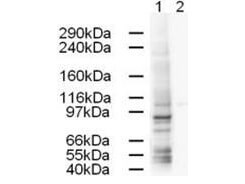
This affinity purified antibody has been tested for use in ELISA and by western blot. Specific conditions for reactivity should be optimized by the end user. Expect a band approximately 91 kDa in size corresponding to AP1G1 by western blotting in the app
Western blot using Rocklands Affinity Purified anti-AP1G1 antibody shows strong detection of a 91-kDa band corresponding to Human AP1G1. Lane 1: HeLa whole cell lysate (p/n W09-000-364). Lane 2: Peptide competition (using 1 µg/ml of the immunizing peptide) blocks the specific reactivity of this antibody with AP1G1. Approximately 20 µg of each lysate was run on a SDS-PAGE and transferred onto nitrocellulose followed by reaction with a 1:500 dilution of anti-AP1G1 antibody. Detection occurred using a 1:5,000 dilution of HRP-labeled Rabbit anti-Goat IgG (p/n 605-4302) for 1 hour at room temperature. A chemiluminescence system was used for signal detection (Roche) using a 60-sec exposure time.
* VAT and and shipping costs not included. Errors and price changes excepted