This affinity purified antibody was prepared from whole rabbit serum produced by repeated immunizations with a synthetic peptide corresponding to an internal region near aa 1120-1145 from the aa1309 yeast Rad9 protein conjugated to KLH.
Conjugation:
Unconjugated
Alternative Names:
Rabbit anti-Rad9 phospho antibody, Rabbit anti-Rad9 pS1129 antibody, Rad 9, Rad-9, Cell cycle checkpoint control protein antibody, Cell cycle checkpoint control protein RAD9A antibody, DNA repair exonuclease rad9 homolog A antibody, DNA repair protein RAD9, YDR217C, YD9934.02C
0.02 M Potassium Phosphate, 0.15 M Sodium Chloride, pH 7.2
Form:
Liquid (sterile filtered)
Target:
Yeast
Antibody Type:
Primary Antibody
Application Dilute:
ELISA: 1:10,000 - 1:50,000, WB: 1:500- 1:2,000
Application Notes:
This phospho specific polyclonal antibody was tested by ELISA. Data from ELISA indicates the antibody is reactive with the phosphorylated form of the immunizing peptide and minimally reactive with the non-phosphorylated form of the immunizing peptide. No
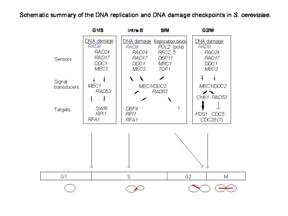
Checkpoints are mechanisms that impose delays in the cell cycle in response to DNA damage or defects in DNA replication, to ensure that mitotic transmission is error-free. Failure to delay the cell cycle in the presence of damage converts an easily reparable DNA lesion into one far more deleterious, provoking genomic instability or cell death. This figure shows a summary of our current knowledge about the DNA damage checkpoints in yeast. Genetic analysis of the pathway has allowed classification of its components into Sensors, which detect different sorts of damage, Signal transducers which are signal-integrating kinases, and Targets which carry out the essential functions of suppressing progress through the cell cycle (i.e. inducing repair genes and preventing late origin firing or sister chromatid segregation. Contributed by C. Frei and K. Shimada, laboratory of S. Gasser, U. Geneva.
* VAT and and shipping costs not included. Errors and price changes excepted