A synthetic peptide corresponding to the N-terminus of rat Caspase-2 protein conjugated to Keyhole Limpet Hemocyanin (KLH) through a cysteine residue linker.
Conjugation:
Unconjugated
Alternative Names:
rabbit anti-Caspase-2 Antibody, Apoptosis related cysteine peptidase antibody, CASP-2, CASP 2 antibody, Casp 2L Pro antibody, CASP2 antibody, Caspase 2 apoptosis related cysteine protease antibody, Caspase2 antibody, Caspase-2, Developmentally down regulated 2 antibody, ICH 1 antibody, ICH-1, Caspase-2 subunit p18, Caspase-2 subunit p13, Caspase-2 subunit p12
0.02 M Potassium Phosphate, 0.15 M Sodium Chloride, pH 7.2
Form:
Liquid (sterile filtered)
Target:
Rat
Antibody Type:
Primary Antibody
Application Dilute:
ELISA: 1:1,500 - 1:6,000, WB: 1:750
Application Notes:
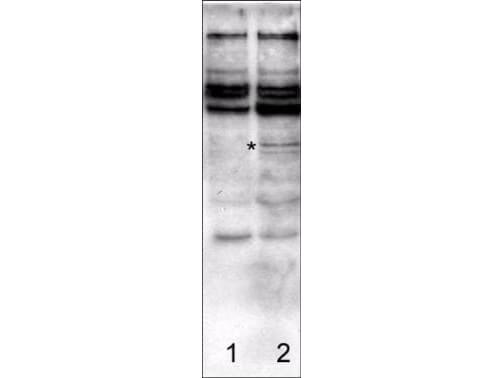
This affinity purified polyclonal antibody was tested by ELISA and immunoblotting and was found to be reactive with 48 kDa mouse and rat caspase-2. A control and rat caspase-2 transfected human 293 cell lysate was used to show by immunoblotting that this
Affinity Purified antibody to Caspase-2was used at a 1:750 dilution to detect rat caspase-2 in transfected human 292 cell lysates (lane 2) by Western blot. Asterisk indicates a 48 kDa caspase-2 protein clearly detected in the rat caspase-2 transfected lysate. No reaction is observed against human caspase-2. Control (lane 1) and transfected (lane 2) lysates were loaded on a 4-20% gel for SDS-PAGE. After primary antibody incubation and washing, a 1:5,000 dilution of HRP conjugated Gt-a-Rabbit IgG (611-103-122) preceded color development using Amershams substrate system. Other detection methods will yield similar results.
* VAT and and shipping costs not included. Errors and price changes excepted