This affinity purified antibody was prepared from whole rabbit serum produced by repeated immunizations with a synthetic peptide corresponding to an internal region of human PNK protein.
0.02 M Potassium Phosphate, 0.15 M Sodium Chloride, pH 7.2
Form:
Liquid (sterile filtered)
Target:
Human
Antibody Type:
Primary Antibody
Application Dilute:
ELISA: 1:3,000 - 1:12,000, WB: 1:300 - 1:1,500
Application Notes:
This affinity purified antibody has been tested for use in ELISA and western blotting. Specific conditions for reactivity should be optimized by the end user. Expect a band approximately 57 kDa in size corresponding to PNK by western blotting in the appr
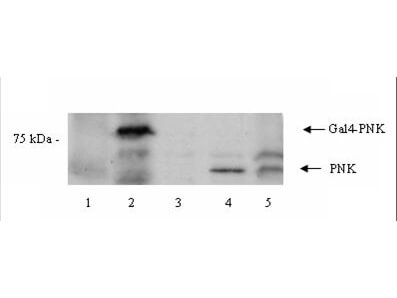
Western blot using Rocklands Affinity Purified anti-PNK antibody shows detection of a 57 kDa band corresponding to human PNK in a Y190 yeast cell lysate (lane 1), Y190 yeast cell lysate + human PNK (Gal DNA BP) (lane 2), EM9 XH Chinese hamster ovary cell lysate (lane 3), EM9 XH Chinese hamster ovary cell lysate + human PNK (lane 4) and a HeLa cell lysate (lane 5). Approximately 10 µg of lysate was run on SDS-PAGE and transferred onto nitrocellulose followed by reaction with a 1:1000 dilution of anti-PNK antibody incubated for 1 hr in TBST at room temperature. Signal was detected using standard techniques.
* VAT and and shipping costs not included. Errors and price changes excepted