This affinity purified antibody was prepared from whole rabbit serum produced by repeated immunizations with a synthetic peptide corresponding to a region approximately 60 residues downstream of the amino terminal end of human Fbp5B protein. Human Fbp5B-2, 466 aa, predicted MW 51.3 kDa
Conjugation:
Unconjugated
Alternative Names:
rabbit anti-F-Box Protein 43/Fbp5B antibody, rabbit anti-F-Box Protein 43 antibody, rabbit anti-Fbp5B antibody, F-box only protein 43, Endogenous meiotic inhibitor 2, FBXO43, EMI2
This affinity-purified antibody has been tested for use in ELISA and western blot. Specific conditions for reactivity should be optimized by the end user. Expect a band approximately 105 kDa in size corresponding to Fbp5B protein by western blotting in t
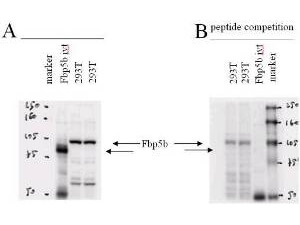
Western blot using Rocklands affinity purified anti-Fbp5B antibody. Panels A and B show two identical membranes containing marker, in vitro translated Fbp5b (Fbp5b ivt), and a whole cell extract from 293T cells loaded in duplicate). Panel A shows antibody reactivity. Panel B shows antibody reactivity after first pre-incubating the antibody with the immunizing peptide. This pre-incubation greatly diminishes specific band recognition. Peptide inhibition completely removes the in vitro translated band and greatly reduces the endogenous band from 293T cells. When this experiment was repeated using a mock in vitro translation, no band was detected (data not shown). Personal Communication, Daniele Guardavaccaro, NYU Cancer Institute
* VAT and and shipping costs not included. Errors and price changes excepted