Toxicity Proliferation and Survival Assay, cell proliferation and cell survival assay, cell viability kit, cell survival kit, cellular viability, cellular survival, HEDS assay, hydroxyethyl disulfide assay, quantifying cell growth and survival, cellular Drug toxicity
Concentration:
None
Application Notes:
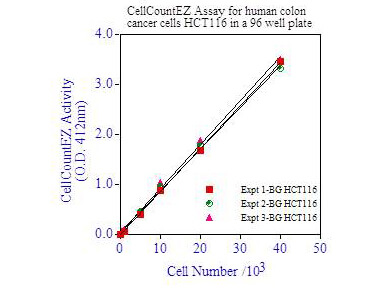
CellCountEZ(TM) Cell Survival Assay Kit contains enough reagents for 1000 assays using a 96-well plate. This assay gives a linear response for cells (0, 1,000, 5,000, 10,000, 20,000, 40,000) plated in 100 µl growth medium with up to 15% fetal bovine serum i
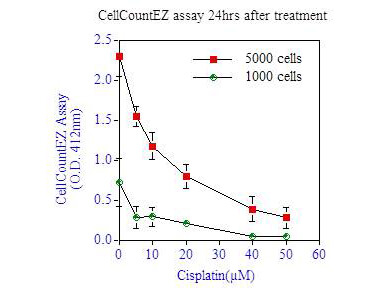
CellCountEZ(TM) Cell Survival Assay Kit is a tissue culture media-based assay that can measure metabolically active live cells and quantify cell death caused by radiation, chemotherapeutics or toxins. CellCountEZ(TM) Assay after 24 hours treament with 0-50 µM of Cisplatin on human colon cancer cells HCT116 in a 96 well plate.
CellCountEZ(TM) Assay for human colon cancer cells HCT116 in a 96 well plate. This assay gives a linear response for cells (0, 1,000, 5,000, 10,000, 20,000, 40,000) plated in 100 µl growth medium with up to 15% fetal bovine serum in a 96-well plate and measured 20 hours after plating. The background (no cells) O.D. is 0.391, 0.381, 0.368 for expt 1,2, and 3 repectively. The r2 values close to 1 demonstrate the dynamic range up to 40,000 cells. y=0.87x-0.008 r2=1.000. y=0.083x+0.045 r2=0.997. y=0.088x+0.052 r2=0.997.
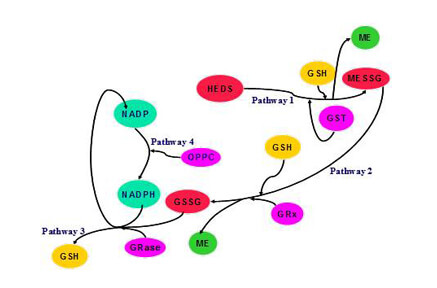
Schematic representation of the various pathways involved in the cellular interactions of HEDS. HEDS reacts spontaneously with glutathione (GSH) or in a reaction catalyzed by glutathione-S-transferase (GST) to produce mixed disulfide (MESSG) of GSH and mercaptoethanol (ME) (Pathway 1). The mixed disulfide MESSG reacts with GSH and produces ME and GSSG by the catalytic action of glutaredoxin (GRX) (Pathway 2). The glutathione disulfide GSSG reacts with NADPH and produces GSH by the catalytic action of glutathione reductase (GRase) (Pathway 3). The conversion of GSSG to GSH i.e. GSH recycling requires NADPH recycling (NADP+ NADPH) by oxidative pentose phosphate cycle (OPPC) (Pathway 4).
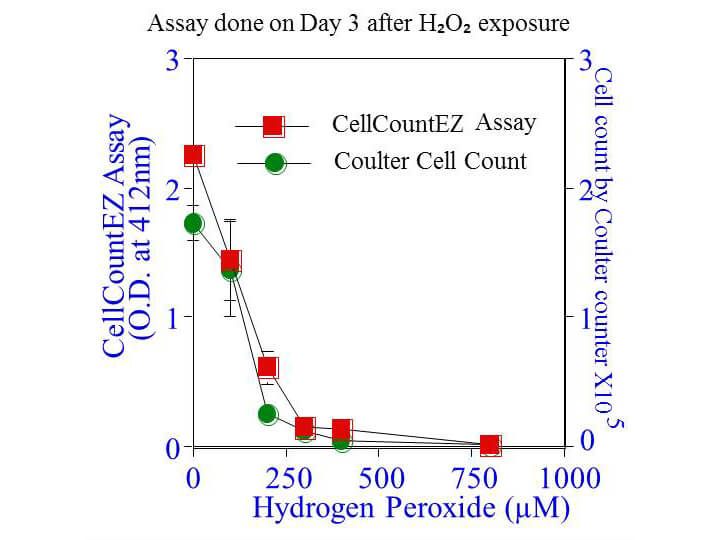
CellCountEZ(TM) Assay after 3 days of treament with 0-1000 µM of hydrogen peroxide on human colon cancer cells HCT116 in a 96 well plate. Drug toxicity could be measured for up to 4 days after treatment with drugs using this assay.
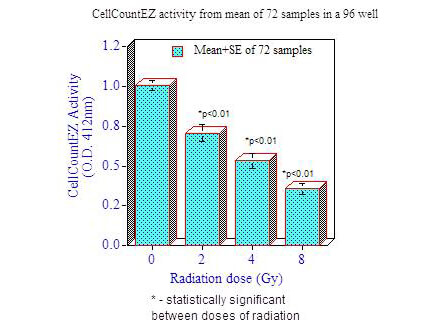
CellCountEZ(TM) activity from the mean of 72 samples in a 96 well. CellCountEZ(TM) Assay after 0-8 doses of radiation on human colon cancer cells HCT116. CellCountEZ(TM) measures mercaptoethanol in the extracellular medium without the need for cellular lysis and extraction methods.
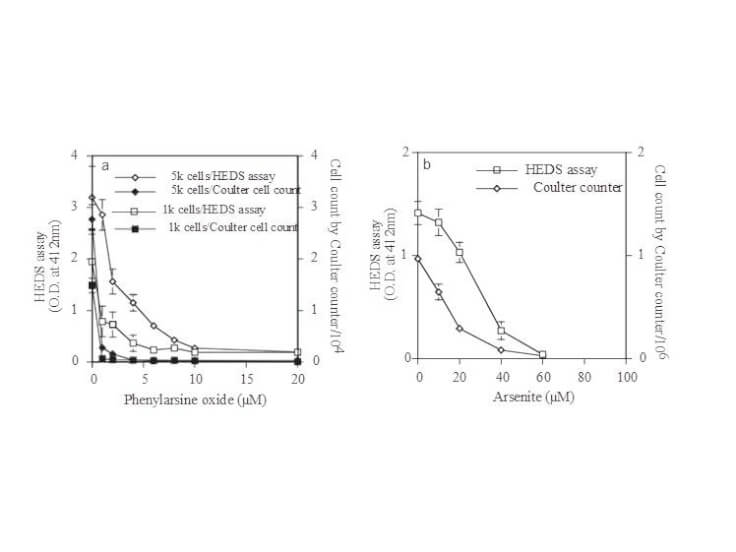
CellCountEZ(TM) Cell Survival Assay Kit is a tissue culture media-based assay that can measure metabolically active live cells and quantify cell death caused by radiation, chemotherapeutics or toxins. HEDS assay after 0-20 µM Phenylarsine oxide treament or 0-60µM Arsenite treatment to human colon cancer cells. CellCountEZ(TM) is based on the ability of mammalian cells to rapidly and efficiently convert hydroxyethyl disulfide (HEDS) into mercaptoethanol (ME) through a bioreduction mechanism.
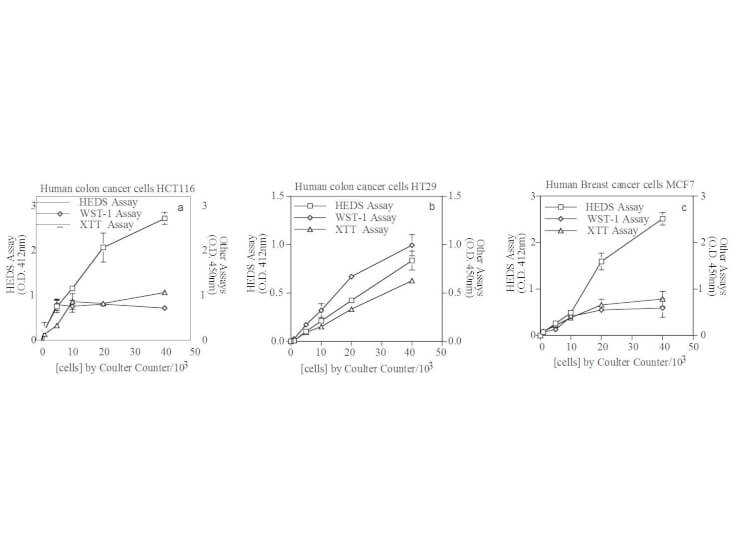
CellCountEZ(TM) Cell Survival Assay Kit is a tissue culture media-based assay that can measure metabolically active live cells and quantify cell death caused by radiation, chemotherapeutics or toxins. HEDS, WST-1, and XTT assays of HCT116, HT29, and MCF7 human cancer cells. CellCountEZ(TM) is based on the ability of mammalian cells to rapidly and efficiently convert hydroxyethyl disulfide (HEDS) into mercaptoethanol (ME) through a bioreduction mechanism.
* VAT and and shipping costs not included. Errors and price changes excepted