![]()
|
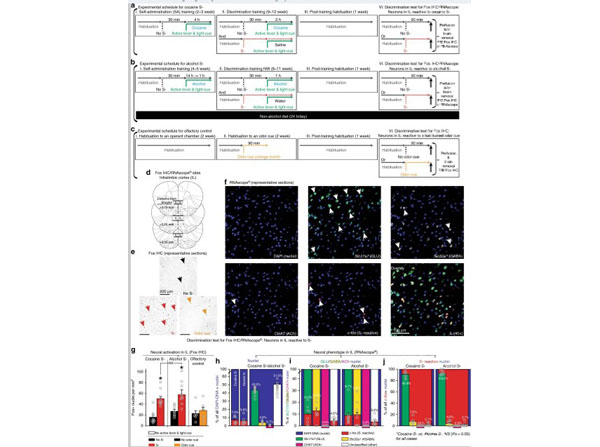
Omission cue-induced suppression (OCIS) procedures for localization and phenotypic characterization of omission cue-reactive neurons in IL. All data are mean and SEM. Gray open circles on bar charts depict individual data-points.a,b,cTimeline and schedule.dTarget sites.e,fRepresentative sections.gEffects of cocaine S-, alcohol S-, and well-habituated odor on neural activation in IL as indicated by Fos immunohistochemistry.n=10,9,8,9,6,6. Two-way between-subjects ANOVA: Training (F(2,42)=4.81,P<0.05) and Cue-Test (F(1,42)=28.67,P<0.001) main effects, and TrainingxCue-Test interaction (F(2,42)=3.77,P<0.05). *P<0.001 vs. No S-. Tuckey HSD test.h,i,jNeural phenotypes in IL reactive to cocaine or alcohol S- as indicated by in situ hybridization via 4-plex RNAscope targetingc-fos,Slc17a7,Slc32a1, andCHAT, as markers for ''S- reactive, ''glutamatergic (GLU), ''GABAergic (GABA), and ''cholinergic (ACh) nuclei. Each nucleus was identified by DAPI. For statistical analyses, total numbers of nuclei per mm2that satisfied each phenotypic criterion were used. For graphic representations, percentages of each phenotype within a specific ''parent phenotype were used.hPercentages of different phenotypes within all DAPI-positive nuclei.n=7,8,15. Individual data-points are not overlaid on the right panel for clarity becausen=15. For this panel, data from rats tested for cocaine S- and alcohol S- were pooled to represent the overall percentages of different phenotypes independent of neural activity. Two-way mixed ANOVA: Phenotype (F(4,52)=532.79,P<0.001), but not Group (F(1,13)=4.05, NS) or GroupxPhenotype interaction (F(4,52)=0.34, NS).n=7,8.iPercentages of S- reactive nuclei within different phenotypes. Two-way mixed ANOVA: Phenotype (F(3,39)=38.62,P<0.001), but not Group (F(1,13)=2.5, NS) or GroupxPhenotype interaction (F(3,39)=1.74, NS).jPercentages of different neural phenotypes within S- reactive nuclei. Two-way mixed ANOVA: Phenotype (F(3,39)=27.77,P<0.001), but not Group (F(1,13)=2.20, NS) or GroupxPhenotype interaction (F(3,39)=2.04, NS).n=7,8. X-gal (5-bromo-4-chloro-3-indolyl beta-d-galactopyranoside) (p/n XGAL-0100). Fig 3. PMID: 31477694. |
![]()
|
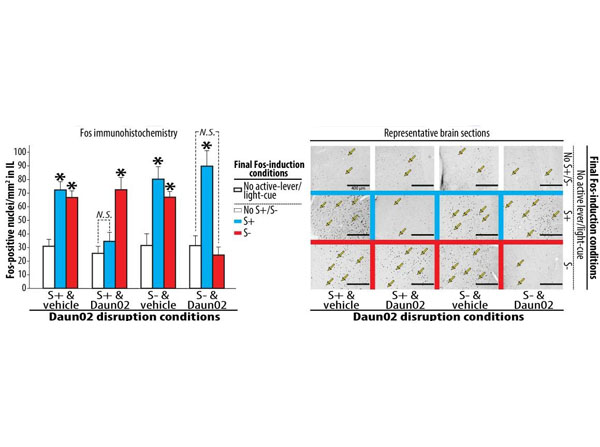
Neural ensembles in IL reactive to S+ or S- following the activity-targeted disruption by Daun02. Each of the four experimental groups, prepared and used for the Daun02 disruption and Post-disruption tests I, was further randomly divided into three groups defined by the type of final Fos induction condition (S+, S- or No S+/S-). The rats were exposed to S+, S- or No S+/S- (control), then deeply anesthetized and euthanized. Brains were collected, sectioned (40 µm), processed for Fos immunohistochemistry. Fos-positive nuclei from sampling areas around the IL microinjection sites were quantified double-blindly. X-gal (p/n XGAL-0100). The average numbers of Fos-positive nuclei per mm2were calculated for each rat and used for statistical analyses. Yellow arrows represent typical Fos-positive nuclei. Group means of these average numbers (+SEM) are depicted. N=7-9, each. *p<0.05-0.01 (vs. No active lever/light-cue). Figure 3. PMID: 27938664. |