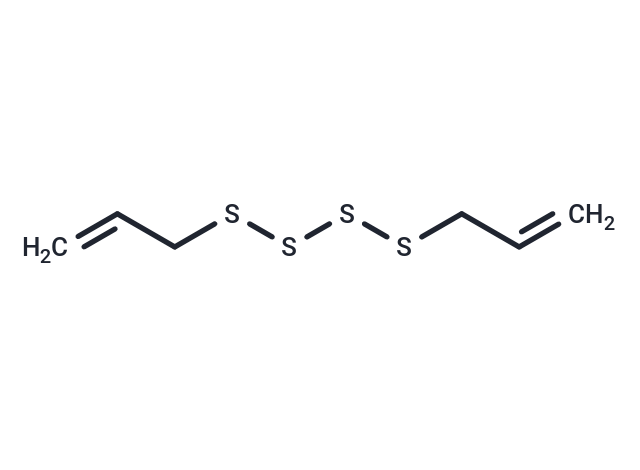
Diallyl tetrasulfide is an organosulfur compound that has been found in A. sativum and has diverse biological activities, including antimicrobial, antioxidant, and anticancer properties.[1],[2],[3],[4] It is active against the bacteria S. aureus and methicillin-resistant S. aureus (MRSA, MICs = 0.5 and 2 mg/L, respectively), as well as the fungi C. albicans, C. krusei, C. glabrata, A. niger, A. flavus, and A. fumigatus (MICs = 0.5, 4, 2, 1, 2, and 4 mg/L, respectively).[1] It reduces cadmium-induced increases in hepatic levels of thiobarbituric acid reactive substances (TBARS) and increases cadmium-induced decreases in the hepatic activity of superoxide dismutase (SOD1), catalase, GST, and glucose-6-phosphate dehydrogenase (G6PDH) in rats when administered at a dose of 40 mg/kg.[2] Diallyl tetrasulfide is cytotoxic to MCF-7 breast cancer cells (IC50 = 92 µM) and reduces tumor growth in a BGC-823 mouse xenograft model when administered at doses of 20, 30, and 40 mg/kg for 32 days.[3],[4]
Molecular Weight:
210.39
CAS Number:
[2444-49-7]
Formula:
C6H10S4
Target:
Others
T36057
* VAT and and shipping costs not included. Errors and price changes excepted