

Microplastics, macro problem
Reference Materials from LGC Standards
 Since 1975, Dr. Ehrenstorfer™ (part of LGC Standards) has led the way in producing pesticide reference standards. Today, the LGC/ Dr. Ehrenstorfer portfolio has expanded to adapt to changing regulations and technology, as they support your need for high quality reference materials for food and environmental analysis.
Microplastics, which are tiny fragments of plastic, are the latest – and possibly the most significant – emerging environmental contaminant to affect the Earth. In addition to regulating microplastics to tackle plastic pollution overall, more efficient testing methods for microplastics must be developed. LGC Standards supports this important issue by providing high-quality microplastic reference materials.
Microplastics, macro problem
What are microplastics?
The US Environmental Protection Agency (EPA) definition of microplastics characterises them as plastic particles ranging in size from five millimetres to one nanometre. Nanoplastics, a subset of microplastics that are all invisible to the naked eye, are defined as being smaller than one micron. The EPA also identifies two microplastics categories: primary microplastics, which are intentionally manufactured for use in consumer products (including cosmetics or biomedical products), and secondary microplastics, a term for plastic particles that have broken down from larger plastic materials (such as synthetic textiles and food wrapping).
Microplastics are everywhere
Mass production of plastics began in the 1940s and 1950s and, because of their versatility, practicality, strength, durability, and low cost, growth in the use of plastics globally has since exceeded that of any other material. The potential impact of this accumulated plastic pollution has now been recognised as an emerging environmental issue. On current forecasts, around 12,000 megatons of plastic will be dispersed around the world by 2050.
Sources of microplastic pollution
Human activity is the main driver of microplastic pollution, worsened by inadequate plastic waste management. A 2024 study of China’s Wei River found that microplastic levels correlated with human factors such as population density, GDP, and proximity to urban areas, along with environmental conditions like water temperature.
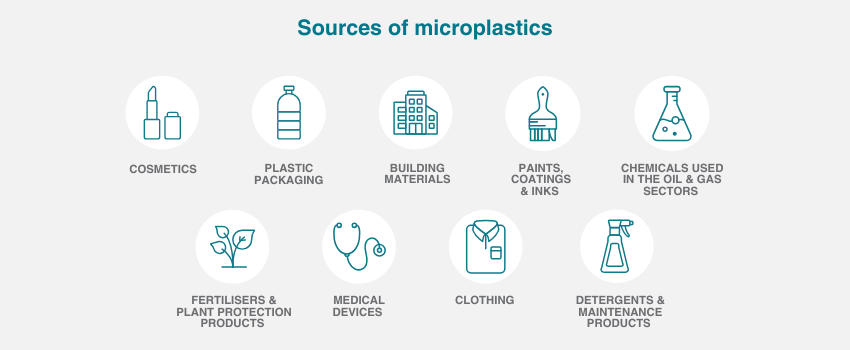
Household sources include products containing microplastics and synthetic textiles that shed fibres during washing. Experiments by the US National Institute of Standards and Technology showed that heating water in LDPE-lined takeaway cups released up to a trillion plastic nanoparticles per litre. Tests on over 250 bottled waters in the US revealed widespread contamination with polymers such as polypropylene, nylon, and PET, averaging hundreds of particles per litre. Agricultural use of plastics in fertilisers, containers, pipes, and films contributes further, as does the application of sludge from wastewater treatment, adding an estimated 430,000 tons of microplastics annually to European farmland. Degraded tyre particles also generate nanoplastics that disperse globally through rain, entering soils and food chains.
The environmental and human health effects of microplastics
Microplastics pose risks to both ecosystems and human health through their persistence and bioaccumulation across food webs. Although wastewater treatment can remove much of the load, significant quantities still reach rivers, oceans, and soils. Aquatic species ingest these particles, exposing humans via seafood consumption, while terrestrial uptake has been observed in crops contaminated by tyre wear particles and sewage sludge. Microplastics have also been detected in honey, salt, and drinking water, with emerging evidence suggesting potential disruption of photosynthesis in plants and threats to biodiversity and food security.
Recent studies have revealed microplastics in human lungs, blood, placentas, and even reproductive organs, raising concerns about long-term physiological impacts, though direct health effects remain uncertain. Researchers warn that plastic particles and their associated chemicals, such as BPA, PCBs, PBDEs, and PFAS, may amplify existing toxic burdens, contributing to disorders ranging from developmental issues to metabolic and cardiovascular diseases. Further investigation is needed to clarify how micro- and nanoplastics interact with biological systems and contribute to cumulative environmental and health risks.
Can better reference materials deliver better microplastic testing and regulation
Regulation of microplastics remains in its early stages. Global progress includes bans on microbeads in personal care products, first introduced in the Netherlands in 2014 and subsequently adopted by the US, UK, China, Japan, Australia, and New Zealand. The EU’s “glitter ban,” effective September 2023, prohibits loose plastic glitter and related products, with phased restrictions on cosmetics and personal care items planned through 2035. The European Chemicals Agency has also proposed reporting requirements for remaining permitted microplastics to improve monitoring and risk assessment.
Testing for microplastics faces major challenges due to the diversity of particle sizes, densities, and compositions. The EPA emphasizes the urgent need to standardize methods for collection, extraction, quantification, and identification across media such as water, sediment, and biota. A key barrier has been the lack of high-quality reference materials, which are essential for consistent analysis and regulatory guidance. Encouragingly, efforts by LGC Standards are beginning to address this gap, potentially enabling more reliable testing and informed regulation.
New microplastic reference materials from LGC Standards
LGC Dr Ehrenstorfer now offers a groundbreaking range of microplastic reference materials to enhance and support your environmental research, method development, and testing.
Certified to ISO/IEC 17025, and accompanied by comprehensive Certificates of Analysis, the new range features the most common microplastics encountered in analysis: polyethylene (PE) and polypropylene (PP), plus nylon (N66) and polyester (PET) fibres. The new standards are expertly designed to bring seamless harmonisation across microplastics testing – whilst also addressing future regulation and empowering you to stay ahead, drive innovation, and confidently meet emerging regulatory standards. These PE and PP microplastics standards are both available in five different particle sizes, with one size each for the N66 and PET versions. All are provided in a 50mg pack size to meet your requirements.
Provided as pure polymers with specific particle size distribution, the new range makes possible:
- targeted testing to identify specific microplastic types in environmental matrices
- accurate, non-biased investigations without interference from other materials
- simplified and reliable sample preparation
- a huge range of studies, from environmental research to toxicology testing and more
LGC Standards is unique in offering both fibres and spherical particles, meaning that you can test a full range of microplastics at once – not only improving your productivity and profitability, but also establishing a positive, forward-facing reputation for your laboratory as it works towards better consumer and environmental safety.The jet milling technique the company has used to manufacture their new reference materials also enables them to provide highly accurate particle size counts for PE and PP – saving you money on expensive equipment and internal standard preparation, and giving you even more confidence that your results are error- and bias-free.
30.10.2025